Product Review Software Comparison for Ecommerce Brands
Product Review Software Comparison for Ecommerce Brands — a practical guide for ecommerce stores. Learn how to build a more effective review collection process with better timing, messaging, and workflow.
Quick answer
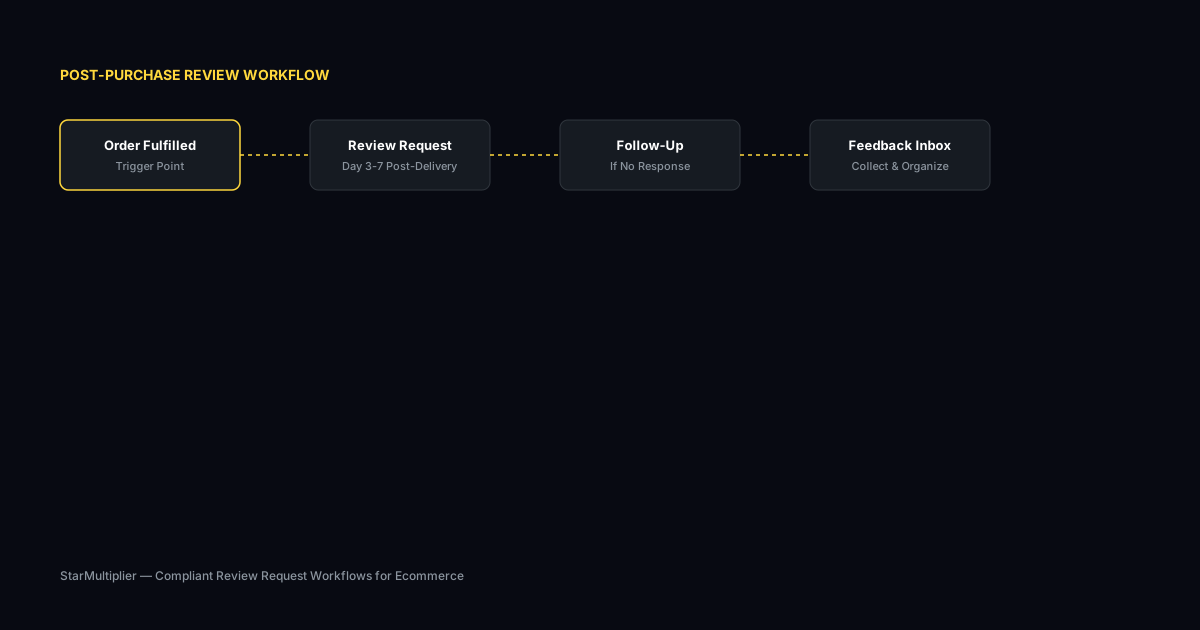
A product review software comparison helps ecommerce brands evaluate how different platforms handle the complete review lifecycle from request automation and feedback collection to response management and analytics.
What is product review software comparison?
A product review software comparison helps ecommerce brands evaluate how different platforms handle the complete review lifecycle. The lifecycle includes request automation, feedback collection, response management, analytics, and sometimes display integration. Each platform approaches these stages differently, and understanding these differences helps brands choose software that supports their specific workflow and goals.
Why product review software comparison matters for ecommerce stores
The right product review software affects more than just review volume. It impacts team productivity, customer satisfaction with the post-purchase experience, and the quality of feedback you receive. A well-chosen platform makes it easy for customers to leave reviews and easy for your team to manage them. A poorly chosen platform creates friction for both sides.
How to approach product review software comparison
Evaluate platforms across the complete review lifecycle, not just request automation. Consider how each platform handles response management, whether it provides a central inbox for monitoring feedback, and how it surfaces insights from collected reviews. The best platform for your brand covers the entire lifecycle without requiring multiple tools stitched together.
Assess your current review collection process
Start by reviewing how you currently collect reviews. Are you using automated requests, manual emails, or no structured process at all? Understanding your starting point helps you choose the right improvements.
Define your review collection goals
Set realistic targets based on your order volume. A store processing 100 orders per week might target 10-15 new reviews per week with an optimized request workflow.
Implement and iterate
Choose the right approach for your store size and implement it. Monitor response rates and adjust timing, messaging, and targeting based on performance data.
Step-by-step product review software comparison framework
First, map your complete review lifecycle from order placement through review publication. Identify where your current process works well and where it creates friction. Second, evaluate how each candidate platform addresses each stage of the lifecycle. Third, prioritize platforms that cover the most stages without requiring additional tools. Fourth, test the top two platforms with real order data. Fifth, choose the platform that covers your most important lifecycle stages most effectively.
Practical examples
A brand selling home goods compared three product review platforms by testing each with a subset of orders. Platform A excelled at request automation but lacked response management features. Platform B had strong response tools but weak analytics. Platform C provided balanced coverage across all lifecycle stages. The brand chose Platform C even though it was not the best in any single category because it eliminated the need for multiple tools. Another brand prioritized analytics depth and chose a platform that provided detailed sentiment analysis and trend detection.
Example for growing stores
A mid-size store processing 300 weekly orders implemented automated review requests and saw review volume increase from 15 to 40 reviews per month within eight weeks.
Example for small stores
A boutique store with 50 weekly orders used targeted template messages for first-time buyers and repeat customers separately, improving response rates by 25 percent.
Common mistakes to avoid
A common mistake is comparing platforms based on request automation alone. A platform that sends beautiful requests but provides no response management or analytics creates new problems instead of solving them. Another mistake is choosing a platform based on a single feature that sounds impressive but is rarely used. Focus on the features you will use daily rather than the features that sound best in a demo.
Inconsistent timing
Sending requests at random intervals confuses customers and reduces response rates. Consistent timing based on delivery windows produces better results.
Generic messaging
Using the same message for every customer misses the opportunity to tailor requests by customer segment and purchase history.
product review software comparison checklist
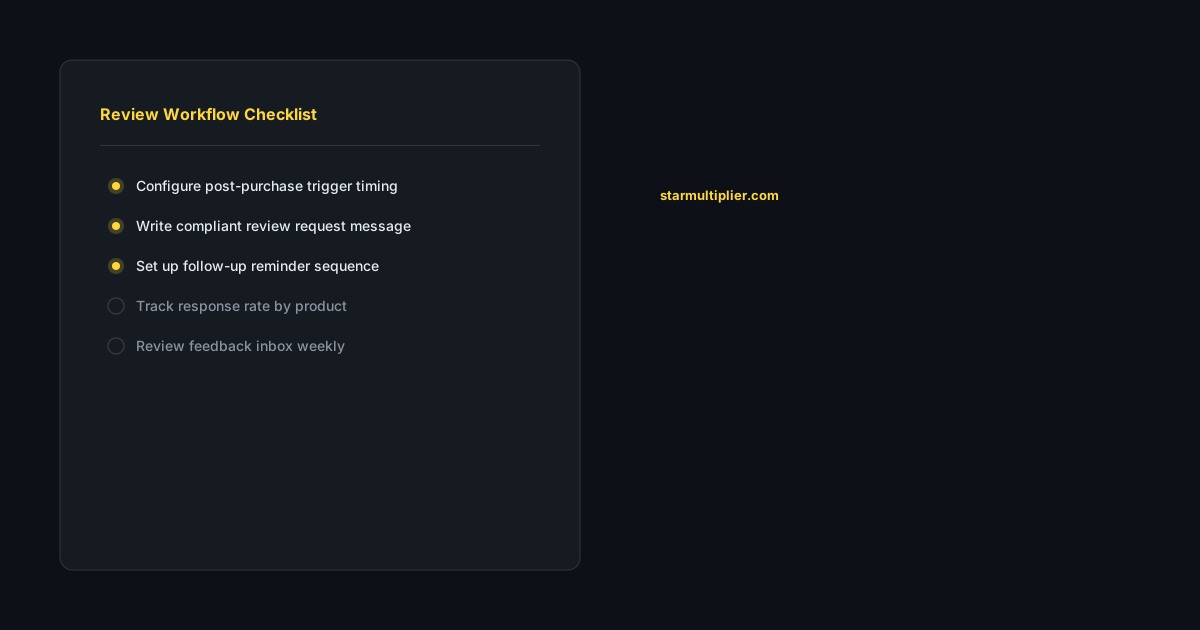
Evaluate each platform across all four lifecycle stages: request automation, feedback collection, response management, and analytics. Note which stages each platform handles natively and which require workarounds. Test the platforms with your actual order data rather than demo environments. Ask each vendor to walk through a complete review lifecycle from their platform rather than just showing individual features.
How StarMultiplier helps with product review software comparison
StarMultiplier covers the complete product review lifecycle with a focused set of tools that work together seamlessly. The platform automates review requests with delivery-based timing, provides a central inbox for monitoring and responding to feedback, and offers analytics that show performance across the entire funnel. Brands using StarMultiplier manage their complete review workflow from a single platform without stitching together separate tools.
Want to see where your review workflow is leaking opportunities? Start with a StarMultiplier review audit.
Key dimensions for comparing product review software
Comparing product review software across the right dimensions produces a decision that serves your store's actual needs rather than a decision driven by marketing presentations. The most important comparison dimensions for ecommerce product review software are: ecommerce platform integration quality, which determines how reliably order data flows into the review request workflow; review collection automation, which covers trigger types, timing flexibility, segmentation, and follow-up management; on-site review display capabilities, which cover widget design, placement options, filtering, and schema markup for search rich snippets; review platform network, which covers which external review destinations the software supports; compliance posture, which covers whether the software includes prohibited features like review gating; analytics and reporting depth; and pricing model scalability. Not all of these dimensions are equally important for every store. A store that only needs to collect reviews for its own on-site product pages has different requirements than one that needs to distribute reviews across multiple external platforms. A store with a single product category has different segmentation needs than one with ten categories. Calibrate which dimensions matter most for your specific situation before evaluating any specific software.
Compliance as a differentiator in product review software comparison
Compliance posture is increasingly a primary differentiator in product review software comparison as platform policies have tightened and regulatory enforcement has increased. Software that was built with review gating as a core feature faces growing risk as Shopify, Google, and Trustpilot have updated their policies to explicitly prohibit selective solicitation. Stores that rely on non-compliant features face the risk of having reviews removed, accounts penalized, or being required to migrate to compliant software under time pressure following a policy enforcement action. Evaluating compliance posture requires asking specific questions rather than accepting general assurances that the software is compliant. Ask: does the software include any feature that routes customers to different review platform links based on their satisfaction score or response to a pre-screening question? Does it offer any satisfaction pre-screening feature, and if so, does the vendor recommend against using it for compliance reasons? Does the software support or facilitate any form of incentivized reviewing, and if so, does it provide disclosure guidance specific to each platform? A vendor that cannot answer these questions clearly, or whose answers reveal non-compliant features in their product, presents compliance risk that should be weighted heavily in your comparison regardless of how attractive other features appear.
Total cost of ownership in a product review software comparison
Total cost of ownership for product review software includes more than the monthly subscription fee. Calculate all cost components before making a final comparison: the base subscription cost at your current order volume, any per-send or per-review charges at your expected volume, SMS costs if you plan to use SMS for review requests, integration costs if middleware is required to connect the software to your ecommerce platform, setup and configuration time cost based on your team's hourly rate, ongoing maintenance time for template updates and workflow monitoring, and the cost of migrating away from the platform in the future if it does not scale with your business. Compare the total cost of ownership over 12 and 24 months rather than just the monthly subscription rate, because some platforms have attractive entry pricing but significant cost jumps at higher volume tiers that make them expensive in the medium term. Also consider the opportunity cost of poor platform performance: a review request tool with a 4 percent response rate costs your business more in lost reviews than one with an 8 percent response rate even if the latter costs more per month in subscription fees. Calculate the economic value of review collection at different response rates to put the software cost in appropriate context.
How to compare product review software for different business models
Product review software comparisons need to be calibrated for your specific business model rather than using a generic evaluation framework that treats all ecommerce businesses as equivalent. Direct-to-consumer brands selling a focused product range should weight template quality and customer relationship features more heavily than multi-channel retailers who need platform-wide coverage. Subscription ecommerce brands should weight follow-up cadence flexibility and repeat-purchase suppression logic more heavily than one-time purchase stores. Multi-brand operators managing separate Shopify stores for different brands should weight multi-account management and cross-brand reporting more heavily than single-brand operators. B2B ecommerce brands should weight features for business customer communication — more formal tone, account-level rather than individual-level review requests, and integration with B2B account management tools — more heavily than consumer-facing brands. High-volume commodity sellers should weight scalability and cost-per-order economics more heavily than boutique brands for whom template quality and relationship features justify higher per-order costs. Define your business model characteristics before evaluating any specific product, and apply those characteristics to weighting your evaluation criteria so the comparison reflects your actual requirements rather than generic best practices.
Building a product review software comparison report for internal stakeholders
Building a product review software comparison report for internal stakeholders who will approve the purchase decision requires presenting the evaluation in terms that are meaningful to non-technical decision-makers. Structure the report in four sections. First, the business problem: describe specifically what your current review collection process is missing, how that gap affects the business (lower conversion, lost customer intelligence, compliance risk), and what improvement you expect from a better solution. Second, the evaluation methodology: explain how you evaluated candidates, including trial period testing with real order data, specific criteria and how you weighted them, and direct comparison on the most critical dimensions. Third, the recommendation: present your top choice with specific evidence for why it performs better than alternatives on your priority criteria, including direct comparison data from trial periods where available. Fourth, the investment and return: present the total cost of ownership including subscription, setup time, and ongoing maintenance, alongside a realistic estimate of the business value from improved review collection including conversion rate improvement estimates, team time savings, and risk reduction from compliance-forward design. This structure gives decision-makers the context they need to approve the investment confidently without requiring them to understand the technical details of the evaluation.
How to weight review compliance posture in a product review software comparison
Review compliance posture should receive disproportionate weight in a product review software comparison relative to most other evaluation criteria because non-compliance carries asymmetric risk. A product that underperforms on template flexibility or reporting depth costs you optimization opportunity — a real cost, but a recoverable one. A product that leads you into non-compliant review collection practices can result in review removal, account suspension, or regulatory action — costs that are significantly higher and harder to recover from. Weight compliance posture at a minimum of 25 percent of your overall evaluation score, and make it a disqualifying factor: a product that cannot meet basic compliance standards should not make your final comparison regardless of how well it performs on other criteria. Evaluate compliance posture not just on the absence of prohibited features but on the positive presence of compliance-enabling design: are templates designed to invite honest feedback? Is the suppression logic designed around legitimate criteria? Does the vendor provide compliance documentation? Is the vendor's stated compliance position consistent with the platform's technical implementation?