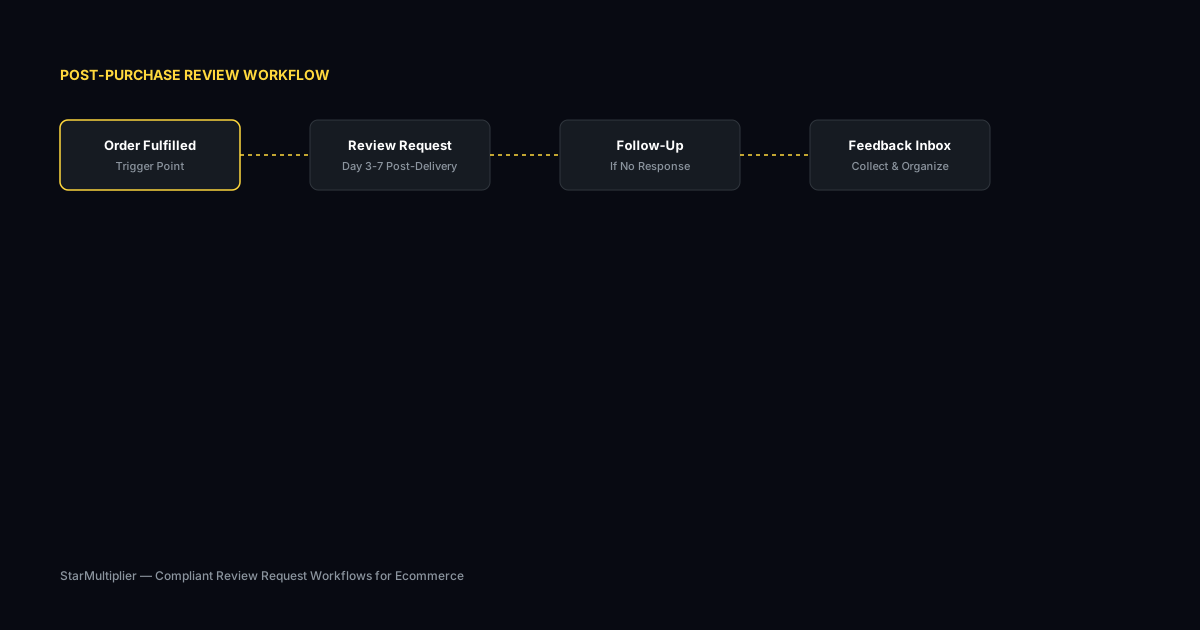
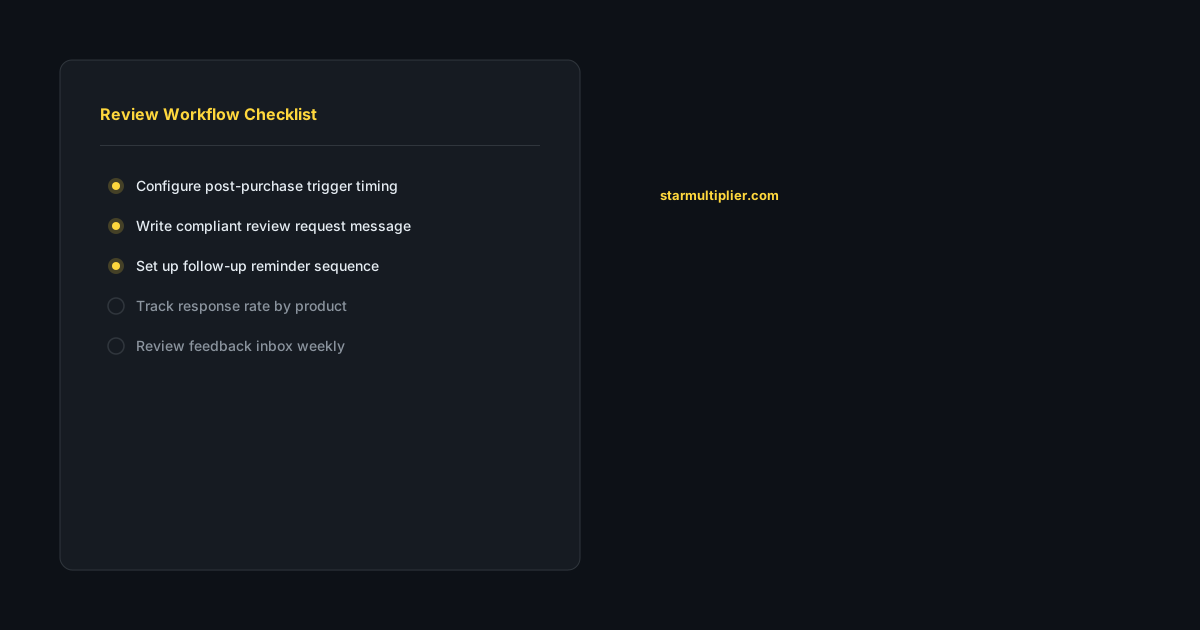
Ecommerce Review Tool Comparison: What Features Matter Most?
Ecommerce Review Tool Comparison: What Features Matter Most? — a practical guide for ecommerce stores. Learn how to build a more effective review collection process with better timing, messaging, and workflow.
Quick answer
A thorough ecommerce review tool comparison helps store owners evaluate platforms across timing flexibility, compliance safeguards, multi-channel support, analytics depth, and integration ease. Understanding which features matter most for your specific store leads to a better purchasing decision.
What is ecommerce review tool comparison?
An ecommerce review tool comparison requires evaluating platforms across several critical dimensions that directly impact review collection effectiveness. The most important factors are timing flexibility, compliance safeguards, multi-channel support, analytics depth, and integration quality. Each dimension matters differently depending on your store size, industry, and team structure.
Why ecommerce review tool comparison matters for ecommerce stores
A structured comparison prevents costly purchasing mistakes. Switching review tools after a few months wastes time and disrupts your collection workflow. Getting the evaluation right the first time saves months of setup and adjustment. This is why understanding which features matter most for your specific store leads to a better purchasing decision and more consistent review collection results.
How to approach ecommerce review tool comparison
Create an evaluation framework before starting your comparison. Define success metrics based on your store goals. For example, if your primary goal is increasing review volume, prioritize tools with strong automation and follow-up capabilities. If your primary goal is maintaining compliance, prioritize tools with built-in policy checks and audit trails. Score each tool against your framework rather than comparing feature lists side by side.
Assess your current review collection process
Start by reviewing how you currently collect reviews. Are you using automated requests, manual emails, or no structured process at all? Understanding your starting point helps you choose the right improvements.
Define your review collection goals
Set realistic targets based on your order volume. A store processing 100 orders per week might target 10-15 new reviews per week with an optimized request workflow.
Implement and iterate
Choose the right approach for your store size and implement it. Monitor response rates and adjust timing, messaging, and targeting based on performance data.
Step-by-step ecommerce review tool comparison framework
Begin the comparison by listing your top five requirements ranked by importance. Research tools that explicitly address each requirement. Create a scorecard with weighted categories based on your priorities. Request demonstrations from the top three tools and ask them to speak to your specific requirements. After demos, choose two tools for trial periods of at least two weeks. Compare results against your predefined success metrics.
Practical examples
A store compared three review tools using a weighted scorecard covering timing flexibility, analytics quality, and setup time. Tool A scored highest on features but required four hours of setup time. Tool B had fewer features but integrated in under 30 minutes. The store chose Tool B because the faster setup meant they could start collecting reviews sooner, and the features it had were the ones they actually needed. Another store prioritized compliance features and chose a tool with built-in policy enforcement even though it had slightly fewer timing options.
Example for growing stores
A mid-size store processing 300 weekly orders implemented automated review requests and saw review volume increase from 15 to 40 reviews per month within eight weeks.
Example for small stores
A boutique store with 50 weekly orders used targeted template messages for first-time buyers and repeat customers separately, improving response rates by 25 percent.
Common mistakes to avoid
One mistake is comparing tools based on pricing alone. A cheaper tool that requires significant manual work may cost more in team time than a more expensive tool that automates the process fully. Another mistake is comparing tools based on demos rather than trial experience. Demo environments often use ideal scenarios that do not reflect real-world conditions. Always run a trial with actual order data before making a final decision.
Inconsistent timing
Sending requests at random intervals confuses customers and reduces response rates. Consistent timing based on delivery windows produces better results.
Generic messaging
Using the same message for every customer misses the opportunity to tailor requests by customer segment and purchase history.
ecommerce review tool comparison checklist
Create a weighted scorecard before starting your evaluation. Include categories for timing flexibility, integration depth, analytics quality, compliance features, and ease of use. Score each tool in every category based on trial experience rather than demo presentations. Ask each vendor how their tool handles specific scenarios relevant to your store rather than watching generic feature tours.
How StarMultiplier helps with ecommerce review tool comparison
StarMultiplier performs strongly in ecommerce review tool comparisons because of its focused feature set and rapid setup time. The platform offers delivery-based timing, native Shopify and WooCommerce integration, detailed analytics showing review funnel performance, and built-in compliance safeguards. Stores comparing StarMultiplier against broader platforms often find that the focused feature set covers their essential needs without the complexity of larger tools.
Want to see where your review workflow is leaking opportunities? Start with a StarMultiplier review audit.
How to structure a meaningful ecommerce review tool comparison
A meaningful ecommerce review tool comparison requires a structured methodology rather than a side-by-side feature matrix that treats every capability as equally important. Begin by identifying your three to five most critical requirements based on your specific operational context and the gaps in your current process. Weight these requirements by importance so that differences in critical capabilities influence your decision more than differences in secondary features. Use this weighted framework to evaluate each tool in your comparison rather than counting total features, which produces misleading rankings when a tool has many features you will never use and few of the ones you care about most. Include compliance posture as an explicit evaluation criterion in every ecommerce review tool comparison. A tool that provides excellent segmentation, beautiful templates, and strong analytics but includes review gating or selective solicitation features creates platform policy risk that could cost far more than its monthly subscription fee in brand damage and enforcement penalties. Evaluate compliance explicitly by asking each vendor whether their tool includes review gating features, by reading their documentation about the features they offer, and by checking whether their marketing claims about results are compliance-consistent or imply manipulation of review ratings.
Feature categories that matter most in an ecommerce review tool comparison
Ecommerce review tool comparisons should prioritize feature categories in roughly this order: integration quality, timing and automation capability, template flexibility, compliance features, analytics and reporting, and pricing model. Integration quality is the foundation: a tool that does not integrate cleanly with your Shopify or WooCommerce store will require manual workarounds that undermine the time-saving value of automation. Test integrations with real orders during trial periods rather than relying on vendor claims about integration depth. Timing and automation capability determines whether review requests reach customers at the optimal moment and whether follow-up sequences run correctly for all customer scenarios. Template flexibility determines whether your review requests feel relevant and personal or generic and transactional. Compliance features determine whether the tool creates platform policy risk through prohibited features or whether its design explicitly supports compliant collection practices. Analytics and reporting determine whether you can understand how your workflow is performing and identify improvement opportunities from the data available. Pricing model determines whether the tool remains cost-effective as your order volume grows and whether the pricing structure aligns with the value you receive.
Running a 30-day trial comparison between ecommerce review tools
A 30-day trial period provides enough data to compare ecommerce review tools meaningfully if you use the trial period actively rather than passively. Configure each tool as close to your intended production setup as possible during the trial: use your real templates, your actual timing rules, and your real review platform links rather than testing with placeholder configurations. Send review requests to a real segment of your customers during each trial so you can compare actual open rates, click-through rates, and response rates rather than estimating performance from demos. Track setup time for each tool separately: how long did it take to go from account creation to sending your first review request in production mode? How many support interactions did you need, and how long did they take to resolve? Track configuration flexibility: were you able to set up the workflow you wanted, or did the tool's limitations require you to compromise on your preferred approach? At the end of each 30-day trial, compare the key metrics side by side: response rate, open rate, click-through rate, setup time, support quality, and how well the workflow matched your requirements. Weight these comparisons by your pre-defined criteria priorities to reach a decision that reflects what actually matters for your specific operation.
Side-by-side ecommerce review tool comparison framework
Use this comparison framework when evaluating multiple ecommerce review tools simultaneously. Create a simple scoring matrix with your top five evaluation criteria as columns and each tool you are evaluating as rows. Score each tool 1 to 5 on each criterion based on your direct evaluation during a trial period rather than on vendor claims. Criterion one: Shopify integration reliability, scored on how cleanly order data flows and how reliably triggers fire based on your test orders. Criterion two: compliance posture, scored based on the vendor's explicit answer to the question of whether the tool includes review gating features. Criterion three: template flexibility, scored on how many customer segments and product categories you can address with different templates and timing rules. Criterion four: analytics quality, scored on whether the reporting provides response rate by product and trend data over time. Criterion five: total cost at 2x your current order volume, scored inversely to cost (lower cost at scale scores higher). Weight the criteria by importance to your specific situation and calculate a weighted score for each tool. The highest-scoring tool based on your specific criteria and weights is your best match, regardless of which tool has the most features or the highest marketing visibility.
Red flags and green flags in ecommerce review tool comparisons
Recognizing red flags and green flags during an ecommerce review tool comparison helps you filter candidates more efficiently without needing to spend equal evaluation time on every option. Red flags: the vendor cannot clearly answer whether their tool includes review gating features; the vendor makes guarantees about specific review volumes or rating improvements; the vendor does not offer a free trial with real order data; references from similar stores are unavailable or the vendor declines to provide them; the pricing page has significant ambiguity about what is included in each tier; the app has a pattern of negative reviews in the Shopify app store related to support quality or reliability. Green flags: the vendor explicitly documents that their tool does not include review gating and explains their compliance approach in writing; the vendor offers a trial period with real order data and genuine configuration support; the vendor can connect you with reference customers similar to your store without hesitation; pricing is transparent and stable with no hidden per-send charges at scale; the vendor has a consistent track record of platform availability and responsive support based on app store review history; the vendor provides data export capabilities so you are not locked in if you choose to switch.
How to compare ecommerce review tool customer support quality
Customer support quality is a critical but often underweighted criterion in ecommerce review tool comparisons because it is the most difficult to evaluate from marketing materials or feature lists and requires direct experience to assess. Evaluate support quality systematically across all tools you are comparing by submitting the same support request to each tool's support team during your trial period. Ask a specific, non-trivial configuration question that requires genuine expertise to answer — not a question that an FAQ could address — and evaluate each vendor's response on four dimensions: response time, technical accuracy of the answer, completeness of the explanation, and whether the response treated you as a knowledgeable operator or as a novice who needed to be talked through basic concepts. Also evaluate the support channel availability: does the vendor offer live chat for time-sensitive issues, or only email support with multi-day response times? Is there a community forum where you can learn from other users' experiences? Is there a knowledge base with genuinely useful, current documentation? These support quality dimensions are strong predictors of the ongoing vendor relationship you will experience as a customer.