How Reviews Build Customer Trust on Ecommerce Product Pages
How Reviews Build Customer Trust on Ecommerce Product Pages — a practical guide for ecommerce stores. Learn how to build a more effective review collection process with better timing, messaging, and workflow.

Quick answer
Understanding how reviews build customer trust helps store owners design product pages that convert browsing shoppers into confident buyers. Reviews provide social proof that reduces purchase anxiety and answers common questions.
What is how reviews build customer trust?
Understanding how reviews build customer trust helps store owners design product pages that convert browsing shoppers into confident buyers. Reviews provide social proof that reduces purchase anxiety and answers common questions that shoppers have when they cannot evaluate products in person. The presence of reviews signals that real people have purchased and used the products, which builds credibility.
Why how reviews build customer trust matters for ecommerce stores
Reviews work because they address the fundamental uncertainty shoppers face when buying online. Without physical examination, shoppers must trust that products will meet their expectations. Reviews from other buyers provide firsthand accounts that help shoppers assess quality, fit, and value. The specificity of authentic reviews is far more convincing than marketing copy.
How to approach how reviews build customer trust
Focus on collecting reviews that address the questions your shoppers most frequently ask. If customers often ask about sizing, collect reviews that mention fit accuracy. If they ask about durability, collect reviews that discuss longevity. Reviews that answer common questions serve double duty by providing social proof and reducing customer support inquiries simultaneously.
Assess your current review collection process
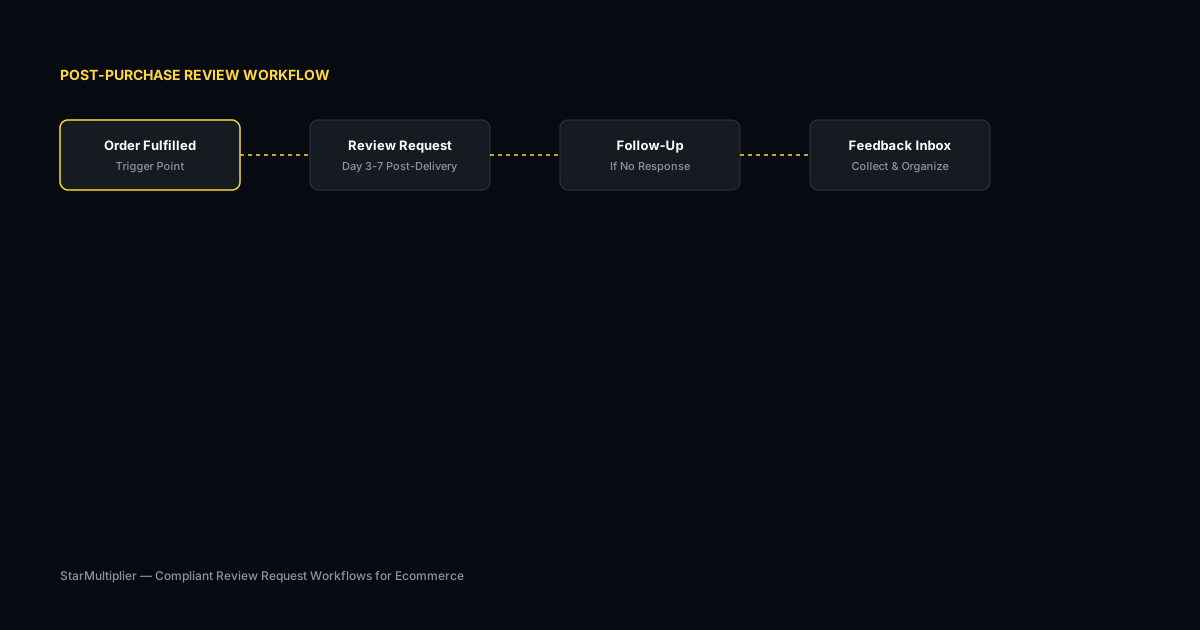
Start by reviewing how you currently collect reviews. Are you using automated requests, manual emails, or no structured process at all? Understanding your starting point helps you choose the right improvements.
Define your review collection goals
Set realistic targets based on your order volume. A store processing 100 orders per week might target 10-15 new reviews per week with an optimized request workflow.
Implement and iterate
Choose the right approach for your store size and implement it. Monitor response rates and adjust timing, messaging, and targeting based on performance data.
Step-by-step how reviews build customer trust framework
First, identify the most common questions your customer support team receives about your products. Second, design your review request to encourage customers to address these specific topics. Third, feature reviews on your product pages that answer these common questions. Fourth, monitor whether featuring specific review content reduces support inquiries for related questions. Fifth, continuously update featured reviews as new relevant content becomes available.
Practical examples
An apparel store found that most customer questions were about sizing accuracy. They updated their review request templates to specifically ask customers about fit: Does this item run true to size? As more reviews included sizing feedback, the store saw a 30 percent reduction in sizing-related customer support tickets. Another store selling skincare products discovered that reviews mentioning specific skin types were the most trusted by shoppers and adjusted their review display to highlight skin-type mentions.
Example for growing stores
A mid-size store processing 300 weekly orders implemented automated review requests and saw review volume increase from 15 to 40 reviews per month within eight weeks.
Example for small stores
A boutique store with 50 weekly orders used targeted template messages for first-time buyers and repeat customers separately, improving response rates by 25 percent.
Common mistakes to avoid
One mistake is displaying reviews without highlighting the most useful content. A simple chronological list of reviews buries the most helpful information. Another mistake is failing to respond to negative reviews. How you handle criticism demonstrates your commitment to customer satisfaction and builds more trust than a perfect but unresponsive review profile.
Inconsistent timing
Sending requests at random intervals confuses customers and reduces response rates. Consistent timing based on delivery windows produces better results.
Generic messaging
Using the same message for every customer misses the opportunity to tailor requests by customer segment and purchase history.
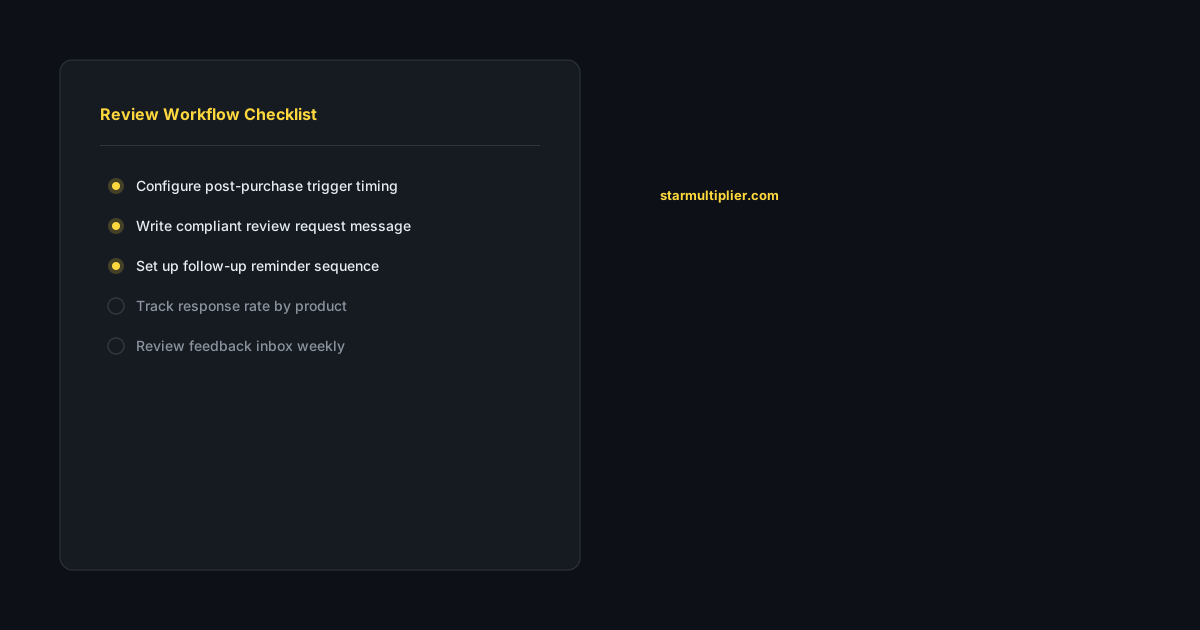
how reviews build customer trust checklist
Identify the three most common questions shoppers ask about your products. Use these questions to guide your review collection and display strategy. Feature reviews that address common concerns prominently on your product pages. Respond to negative reviews professionally and promptly to demonstrate your commitment to customer satisfaction. Monitor the correlation between review content and conversion rates.
How StarMultiplier helps with how reviews build customer trust
StarMultiplier helps stores collect reviews that build customer trust by providing automated request workflows with customizable templates. The platform's analytics show which reviews are most effective at driving conversions, helping you understand the content that builds the most trust with your shoppers.
Want to see where your review workflow is leaking opportunities? Start with a StarMultiplier review audit.
The psychology of how reviews build trust with new customers
The trust-building function of reviews is grounded in well-understood principles of social psychology. When potential customers encounter a new brand or product for the first time, they face a fundamental uncertainty about whether the brand's claims about itself are accurate. Brand-controlled content — advertising, product descriptions, testimonials on the brand's own website — is inherently suspect because the brand has an obvious commercial interest in presenting itself favorably. Reviews from other customers address this credibility gap because the reviewers have no commercial interest in the brand and are reporting their actual experience rather than marketing the brand to others. This peer-to-peer trust mechanism is the core reason reviews are so powerful for conversion: they provide a form of validation that brand content cannot replicate regardless of how well it is written or designed. The trust effect is magnified when reviews are specific and detailed, because specificity is a proxy for authenticity — a reviewer who describes exactly how they used a product in a specific context and what result they experienced is clearly drawing on a real experience rather than writing a generic endorsement. It is further magnified when reviews include a range of ratings rather than uniformly positive scores, because perfect profiles signal curation rather than honest reporting.
How review volume, recency, and rating distribution affect trust
Three measurable characteristics of a product's review profile determine how much trust potential customers place in it: volume, recency, and rating distribution. Volume determines whether the profile is large enough to be statistically meaningful. A single five-star review tells you one person liked the product; 200 reviews with an average of 4.2 stars tells you something genuinely representative about how the product performs for a large sample of buyers. The threshold for meaningful sample size varies by product category and purchase price: shoppers accept thinner evidence for a $15 accessory than for a $300 investment. Recency signals ongoing relevance. A product page where the most recent reviews are from 18 months ago raises questions about whether the product, brand, or service quality has changed since those reviews were written. Shoppers implicitly discount old reviews more than brands realize, which is why maintaining a consistent collection cadence matters more than front-loading collection during a launch period. Rating distribution builds credibility through transparency. A product with some two and three-star reviews alongside a majority of four and five-star reviews looks more authentic than one with exclusively top ratings, because genuine customer experiences produce natural variation rather than uniformly positive outcomes.
How to maximize the trust-building contribution of your reviews
Maximizing the trust-building contribution of your reviews requires both collecting more reviews and collecting better quality reviews that provide the detail and specificity that make them most persuasive to potential customers. Volume matters, so build a consistent collection process that generates a steady stream of new reviews throughout the year rather than concentrating collection efforts during product launch periods. Recency matters, so monitor your review profile monthly to ensure that new reviews are appearing consistently and that the most visible reviews on each product page are from the past six months rather than older. Quality matters, so use your review request template to encourage specific, detailed feedback rather than generic one-line ratings. Open-ended prompts in your review request — asking customers what they use the product for, what they like most, or what they would improve — produce more useful, more persuasive review content than requests that only ask for a star rating. Review response matters too: publicly responding to reviews, particularly critical ones, demonstrates that your brand is attentive and takes customer experience seriously. This responsiveness is itself a trust signal that future shoppers evaluate when they read your reviews, and a well-crafted response to a negative review often converts that review from a trust deficit into a trust builder.
Practical strategies for accelerating trust building through reviews
Accelerating the trust-building contribution of reviews requires both collecting more reviews and ensuring that the reviews you collect are displayed in the most trust-effective way. To collect more trust-building reviews: focus your outreach on customers who purchased your highest-consideration products, who are most likely to write detailed, specific reviews that address the questions potential buyers have. Prompt customers to share specific aspects of their experience — how the product compared to expectations, what they use it for, what they would tell a friend who was considering the purchase — rather than leaving them to decide what to write. To display reviews in the most trust-effective way: ensure the aggregate rating and review count are prominently visible near the product title, include a star distribution breakdown that shows the full range of ratings, and ensure recent reviews are prominently displayed rather than buried below older ones. Respond publicly to critical reviews with constructive, helpful responses that demonstrate your brand's commitment to customer satisfaction. These practices compound over time: more specific reviews build more trust per review than generic ones, and a consistent response practice demonstrates ongoing brand engagement that signals reliability to new shoppers.
How review trust compounds as your brand matures
The trust-building contribution of reviews compounds as your brand matures and your review profile grows. In the early stage of a brand's life, each new review contributes significant marginal trust because the profile is thin enough that every review represents a meaningful addition to the evidence base. A brand moving from 5 to 15 reviews sees a more dramatic trust signal improvement than one moving from 150 to 160 reviews. As the brand matures and review volume grows, the trust contribution of each individual review diminishes while the cumulative trust contribution of the review profile as a whole increases. A brand with 300 reviews averaging 4.3 stars from the past two years has established a durable, statistically credible trust signal that is difficult for new competitors to replicate quickly. This accumulated trust capital is a genuine competitive advantage that grows continuously as long as review collection remains consistent. The brands that invest in systematic review collection from their earliest stages build this trust capital faster and maintain it more durably than those that start review collection as a later-stage optimization initiative.
The role of review volume versus review quality in building customer trust
Research on consumer trust in product reviews reveals a non-linear relationship between review volume and trust: a small number of high-quality reviews builds more trust than a large number of generic or low-quality reviews, but volume continues to matter because it signals consistent demand and current product availability. For stores just beginning review collection, focusing on review quality — specific, detailed, genuine feedback — produces faster trust improvement than focusing only on volume. For established stores with moderate review volume (25 to 50 reviews per product), adding additional volume continues to build trust but the incremental impact of each new review decreases. For stores with high review volume (100+ reviews per product), maintaining freshness and responding to critical reviews publicly produces more trust improvement per unit of effort than simply adding more volume. Understand where each of your key products sits on this volume-quality spectrum and calibrate your review collection priorities accordingly: your lowest-volume products benefit most from any additional reviews, your moderate-volume products benefit from quality improvement, and your high-volume products benefit most from active management through responses and freshness maintenance.