Ecommerce Trust Building Strategy: Using Reviews as a Foundation
Customer trust is the foundation of ecommerce conversion and retention. Learn how to build brand trust systematically using reviews, transparency, and consistent customer experience.

Quick answer
Build ecommerce trust systematically by collecting authentic reviews consistently, displaying them honestly, responding to all reviews publicly, maintaining transparent communication throughout the customer journey, and delivering on every promise your marketing makes.
Why trust is the most important asset in ecommerce
Trust is the single most important factor in ecommerce conversion for first-time buyers because it is the factor that differentiates brands capable of converting strangers into customers from those that cannot. A shopper who trusts your brand will purchase despite price disadvantages, minor product page gaps, and limited social proof. A shopper who does not trust your brand will not purchase despite competitive pricing, excellent photography, and a well-designed checkout flow. The conversion value of trust is enormous — but trust is harder to build than any technical conversion optimization because it is earned through the accumulation of consistent signals over time rather than through any single improvement. Trust signals include product reviews, professional website design, clear contact information, transparent pricing, honest product descriptions, visible return policies, and the absence of manipulative urgency tactics. Each signal contributes marginally, and their combination determines whether a first-time visitor trusts your brand enough to provide their payment information and wait for a product to arrive.
Reviews as the highest-value trust signal in ecommerce
Among all trust signals available to ecommerce brands, authentic product reviews are consistently identified by consumer research as the most influential. Reviews are trusted more than brand statements, more than professional photography, and more than advertising claims because they come from customers who have no financial incentive to praise the product unless their experience genuinely warrants it. The credibility of reviews is highest when they are obviously authentic: specific language rather than marketing phrases, a realistic distribution of ratings including some less-than-perfect assessments, detailed descriptions of real use cases, and visible recency signals that confirm current customers are still satisfied. Building a trust-anchoring review profile requires consistent collection that produces enough volume to be credible, honest display that does not filter or manipulate the visible review set, and public engagement (review responses) that demonstrates ongoing brand commitment to the customer relationship beyond the purchase transaction.
Transparency as a trust multiplier
Transparency multiplies the trust value of every other signal your brand communicates because it signals that your brand has nothing to hide. Transparent ecommerce brands share information that many brands would conceal: honest product specifications without inflated claims, realistic shipping time estimates including their range of variability, clear return policy terms without hidden conditions, honest answers to customer questions that acknowledge limitations alongside strengths. Transparency in review collection is particularly important: brands that make their review collection process visible — explaining clearly that they request reviews from all customers after purchase and display all reviews including negative ones — are more trusted by sophisticated shoppers than brands that appear to have an implausibly high aggregate rating without a visible collection process. Communicating your review collection approach honestly (in a FAQ, a website policy page, or in the review request email itself) is a trust signal that most brands miss because they treat the review collection process as invisible infrastructure rather than as a public commitment to authentic feedback.
Delivering on brand promises to make trust tangible
Reviews build trust up to the moment of first purchase. Delivery on brand promises converts that initial trust into the sustained trust that produces repeat purchases and brand advocacy. The trust cycle works as follows: a new customer is converted by trust signals including reviews. They purchase and have an experience. If the experience matches or exceeds the expectations set by the brand's marketing and social proof, their trust is validated and increased. They become a returning customer, advocate, and potential reviewer who reinforces the social proof cycle for future new customers. If the experience does not match expectations — the product is smaller than implied, the quality is lower than the reviews suggested, the shipping was slower than the promised estimate — their trust is violated and the cycle breaks. Building sustainable ecommerce trust requires that the promises implicit in your marketing, photography, product descriptions, and social proof are consistently delivered by the actual product and customer service experience.
Building trust during the post-purchase period
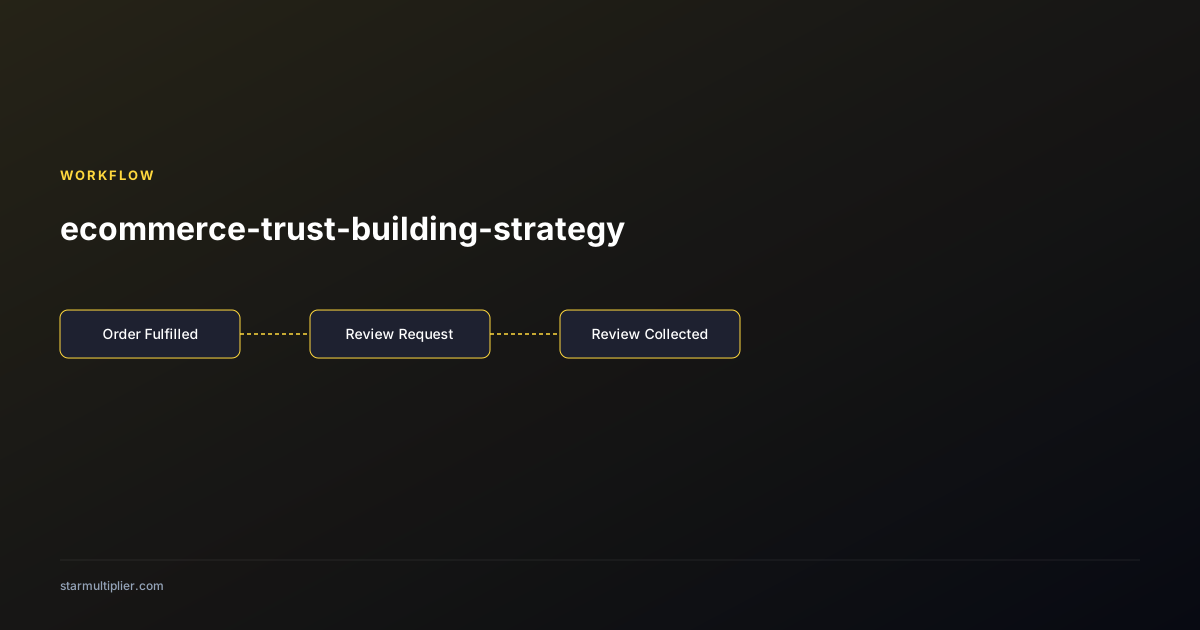
The post-purchase period — from order confirmation through product delivery and beyond — is underutilized as a trust-building opportunity by most ecommerce brands. The post-purchase communication sequence is typically designed for operational purposes (order confirmation, fulfillment notification, delivery tracking) rather than for relationship and trust building. Elevate post-purchase communication to serve both purposes: the fulfillment notification that is also a warm, personal expression of excitement about the customer's upcoming product experience; the delivery check email that is also a genuine invitation for concerns before they become frustration; the review request that is also a caring follow-up that demonstrates interest in the customer's long-term experience. Each post-purchase touchpoint is an opportunity to reinforce trust through demonstrated commitment to the customer's satisfaction that extends beyond the moment the purchase transaction was completed.
Want to see where your review workflow is leaking opportunities? Start with a StarMultiplier review audit.
Measuring trust and its impact on business outcomes
Trust is difficult to measure directly, but its effects are visible in measurable business outcomes. The metrics most directly affected by trust levels are: first-time visitor conversion rate (higher trust produces higher initial conversion), cart abandonment rate (lower trust produces more abandonment at payment), return rate (higher trust produces lower return rates as expectations match experience), and customer lifetime value (higher trust produces more repeat purchases and higher willingness to spend per order). Track these metrics over time alongside your trust-signal improvements — review volume, response rate, and response consistency — and look for correlations that demonstrate the business impact of your trust-building investments. A store that systematically improves its review profile, increases its response rate, and improves its post-purchase communication over 12 months should see measurable improvement in first-time visitor conversion and repeat purchase rates that can be at least partially attributed to the trust improvements made during the period.
Trust signals at the checkout stage: reducing payment hesitation
The checkout stage is where accumulated trust from the rest of the purchase journey must convert into actual payment, and specific trust signals at this final friction point can meaningfully reduce cart abandonment. The three highest-impact checkout trust signals are: visible security indicators (SSL certificate seal, secure checkout badge) near the payment information fields, where they are most relevant to payment hesitation; a concise summary of your return policy near the 'Place Order' button, which addresses the most common pre-payment concern ('What if this doesn't work out?'); and a visible customer service contact option that allows hesitant buyers to get a question answered before committing rather than abandoning. A single-page or streamlined checkout that displays all trust signals on the same page as the payment form is more effective than a multi-step checkout where trust signals appear on early steps and are absent at the payment step where trust is most needed. Test checkout trust signal placement by comparing add-to-cart-to-purchase rates before and after adding or moving trust signals on your checkout page.
Rebuilding trust after a specific product quality failure
A specific product quality failure — a batch of defective units, a manufacturing change that degraded quality, a supplier switch that introduced inconsistency — creates a trust repair challenge that requires both product correction and communication transparency to resolve. The most common trust repair mistake is correcting the product issue silently while continuing to display old reviews that no longer accurately represent the current product quality. This approach perpetuates misaligned expectations for new customers who purchase based on pre-fix reviews and then receive a product experience that matches the quality problem rather than the positive reviews. Transparent trust repair after a quality failure requires: a clear public communication acknowledging the issue (through a product page notice, an email to recent purchasers, or a brand update), a documented description of the fix implemented, and a renewed review collection effort that builds fresh review content from customers who purchased the corrected product. This fresh review cycle, combined with transparent communication, rebuilds social proof credibility by demonstrating that your brand addresses quality issues rather than managing perception around them.
Trust recovery after a data breach or security incident
A data breach or security incident creates a trust recovery challenge of a different magnitude than a product quality failure, because the breach signals a failure of the brand's responsibility to protect customer information rather than a failure to deliver a specific product promise. Trust recovery after a security incident requires exceptional communication transparency, concrete security improvement demonstrations, and patience — because trust rebuilders that feel adequate to the brand may still feel insufficient to affected customers who experienced the loss of personal control that a breach represents. Required trust recovery elements include: immediate and complete disclosure to affected customers of what data was accessed, what risk this creates for them, and what they should do to protect themselves; a detailed communication of the security improvements made in response; and ongoing communication updates at 30, 60, and 90 days that confirm the improvements are in place. Trust recovery time after a security incident is measured in years for brands that handle the incident correctly, and may never fully recover for brands that handle it poorly. The investment in prevention — robust data security practices that prevent incidents — is categorically preferable to the trust recovery investment required after one occurs.
Checklist
- Audit your product page for each of the 5 core trust signals (reviews, return policy, contact info, secure checkout, accurate descriptions)
- Ensure review display is honest — do not filter out negative reviews or pad counts
- Respond publicly to all reviews (positive and negative) within 48 hours
- Verify all product descriptions are accurate and do not exaggerate claims
- Make your review collection process visible through a FAQ or policy page
- Track first-time visitor conversion rate monthly as the primary trust metric
- Survey new customers 30 days after first purchase to understand trust-related purchase barriers