Customer Proof for Ecommerce: Reviews, Ratings, and Feedback
Customer Proof for Ecommerce: Reviews, Ratings, and Feedback — a practical guide for ecommerce stores. Learn how to build a more effective review collection process with better timing, messaging, and workflow.
Quick answer
Customer proof for ecommerce refers to reviews, ratings, testimonials, and user-generated photos that prove your products deliver on their promises. This proof is one of the most powerful conversion tools available.
What is customer proof ecommerce?
Customer proof for ecommerce refers to reviews, ratings, testimonials, and user-generated photos that prove your products deliver on their promises. This proof is one of the most powerful conversion tools available because it comes from real customers rather than your marketing team. Authentic customer proof is persuasive precisely because it is not controlled by the brand.
Why customer proof ecommerce matters for ecommerce stores
Customer proof matters because shoppers are naturally skeptical of brand messaging. Marketing copy describes what a product should do; customer reviews describe what a product actually does. This distinction makes customer proof more convincing than professionally produced content. The more specific and detailed the proof, the more persuasive it becomes.
How to approach customer proof ecommerce
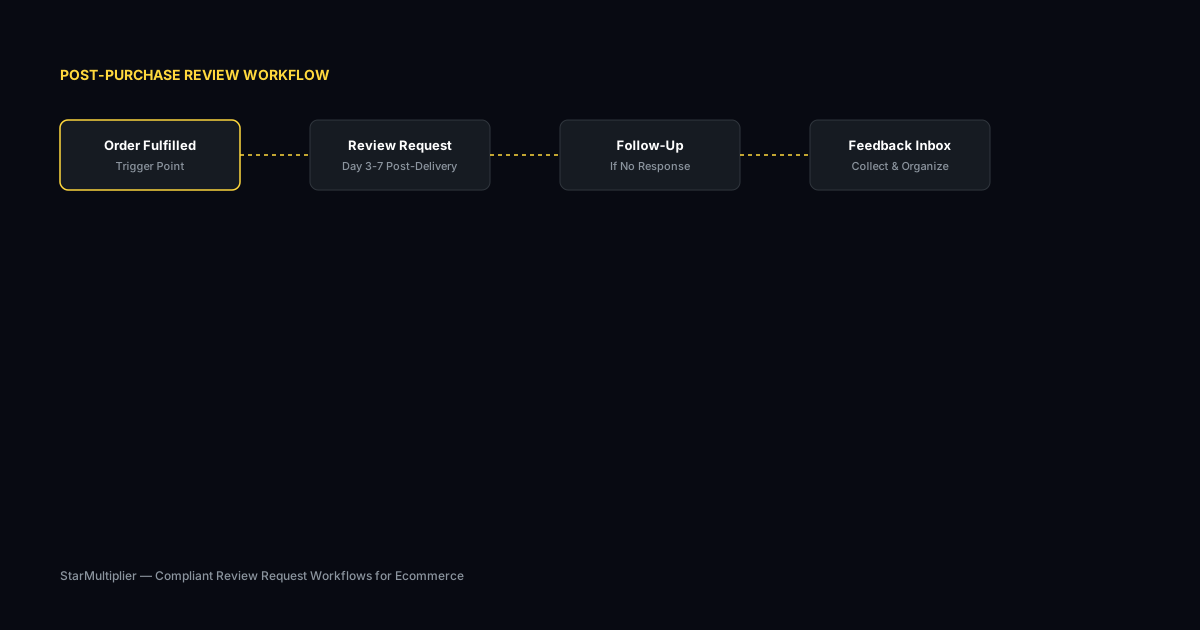
Collect customer proof systematically rather than waiting for it to appear organically. Implement automated review requests that encourage customers to leave detailed feedback including photos when relevant. Make it easy for customers to share their experiences by providing clear instructions and simple submission processes. The easier you make it, the more proof you will collect.
Assess your current review collection process
Start by reviewing how you currently collect reviews. Are you using automated requests, manual emails, or no structured process at all? Understanding your starting point helps you choose the right improvements.
Define your review collection goals
Set realistic targets based on your order volume. A store processing 100 orders per week might target 10-15 new reviews per week with an optimized request workflow.
Implement and iterate
Choose the right approach for your store size and implement it. Monitor response rates and adjust timing, messaging, and targeting based on performance data.
Step-by-step customer proof ecommerce framework
First, implement automated review requests that capture customer feedback consistently. Second, actively encourage photo and video reviews by making the submission process simple. Third, select the most compelling customer proof for prominent display on product pages and marketing materials. Fourth, refresh displayed proof regularly to keep content current. Fifth, measure the conversion impact of customer proof by comparing product pages with and without prominent proof displays.
Practical examples
A furniture store encouraged photo reviews by offering a small incentive for customers who submitted photos of their assembled furniture in their homes. The store received hundreds of authentic room photos that became the most effective conversion tool on their product pages. Products with multiple photo reviews converted at nearly twice the rate of products with text-only reviews. Another store collected video testimonials from their most satisfied customers and featured them prominently on their homepage, resulting in a measurable increase in time spent on the site.
Example for growing stores
A mid-size store processing 300 weekly orders implemented automated review requests and saw review volume increase from 15 to 40 reviews per month within eight weeks.
Example for small stores
A boutique store with 50 weekly orders used targeted template messages for first-time buyers and repeat customers separately, improving response rates by 25 percent.
Common mistakes to avoid
One mistake is curating customer proof too heavily, displaying only perfect testimonials that feel inauthentic. A mix of glowing reviews and constructive feedback is more credible. Another mistake is failing to refresh customer proof regularly. Stale reviews from years ago suggest the business is no longer actively serving customers, which undermines trust.
Inconsistent timing
Sending requests at random intervals confuses customers and reduces response rates. Consistent timing based on delivery windows produces better results.
Generic messaging
Using the same message for every customer misses the opportunity to tailor requests by customer segment and purchase history.
customer proof ecommerce checklist
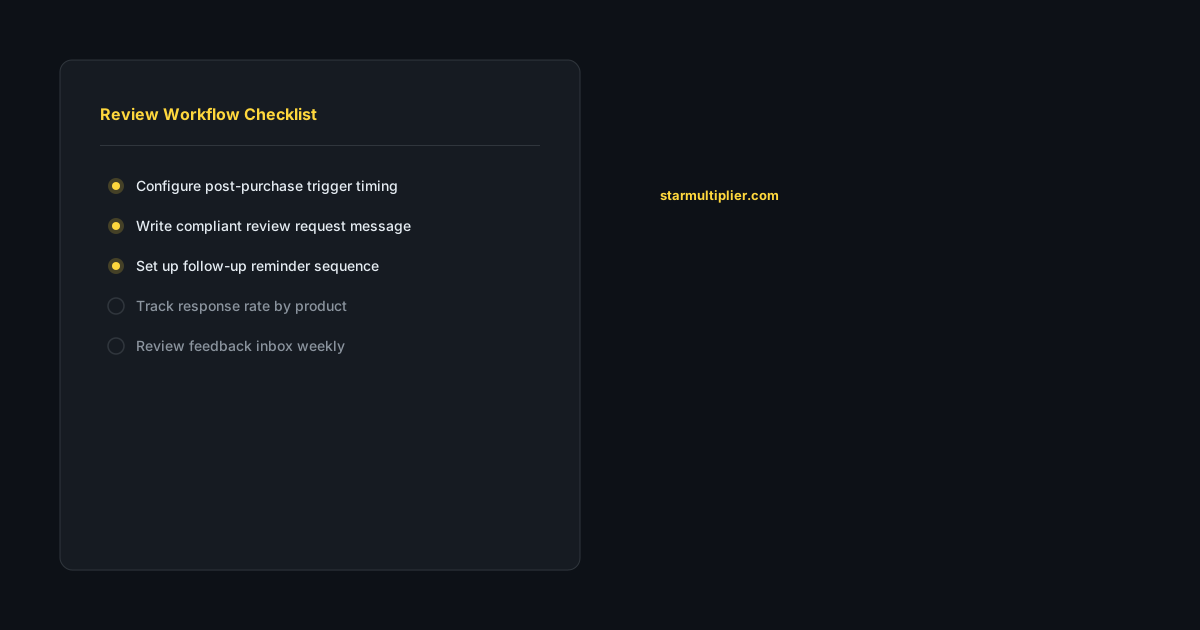
Implement automated systems for collecting customer proof consistently. Encourage photo and video content by making submission easy. Display a balanced mix of positive and constructive feedback for authenticity. Refresh displayed proof regularly to keep content current. Measure the conversion impact of customer proof displays through A/B testing.
How StarMultiplier helps with customer proof ecommerce
StarMultiplier helps stores collect customer proof at scale with automated review request workflows that encourage detailed feedback. The platform supports photo submissions and provides analytics to identify the most compelling customer proof for your product pages. Stores using StarMultiplier build a growing library of authentic customer proof that drives conversions.
Want to see where your review workflow is leaking opportunities? Start with a StarMultiplier review audit.
Types of customer proof that convert ecommerce shoppers
Customer proof in ecommerce takes several distinct forms, each of which serves a different psychological function in the purchase decision process. Product reviews are the most direct form: they provide peer validation from customers who have purchased and used the product and are reporting their honest experience. Review volume and recency signal ongoing customer activity and provide statistical evidence for claims about product quality. Star ratings provide a quick summary signal that shoppers use as a first-pass filter before deciding whether to read individual reviews. User-generated photos attached to reviews provide visual validation that is particularly powerful for products where appearance, fit, or real-world context is important. Customer testimonials on landing pages or featured review sections provide curated social proof that highlights specific customer outcomes or use cases. Purchase count displays showing how many customers have bought a product in a recent period create a form of social validation through popularity: many shoppers interpret high purchase volume as a signal that the product has been validated by a large number of buyers who presumably would not have repeated the purchase if the product did not deliver on its promises. Each type of customer proof addresses different customer concerns and works best in different positions in the customer journey.
Building customer proof systematically for different product stages
Building customer proof systematically requires different strategies for products at different stages of their lifecycle. For newly launched products, the first challenge is the cold start problem: no customer proof exists yet because no one has purchased and reviewed the product. Address this by identifying your most engaged existing customers who purchase across product categories and inviting them to try the new product, with the explicit understanding that you are looking for their honest feedback. This product seeding approach generates early reviews while complying with disclosure requirements — any reviews resulting from seeded products should disclose that the product was received in exchange for an honest review. For established products with thin review coverage, targeted review collection campaigns that prioritize these products specifically can build coverage faster than standard collection across your full catalog. For products with strong review coverage, the goal shifts from building volume to maintaining freshness: ensure that new reviews continue to arrive consistently rather than allowing the profile to age. For declining products with negative trend in ratings, the priority is using review content to understand what has changed and addressing the underlying issue rather than attempting to improve the rating through collection tactics.
Integrating customer proof across your ecommerce marketing channels
Customer proof is most effective when it appears at multiple touchpoints across your customer's journey rather than only on product pages. Email marketing campaigns that include customer review quotes or aggregate ratings have higher click-through rates than campaigns without social proof because they pre-validate the products being featured before the customer reaches the product page. Social media content that features customer-submitted photos or review quotes provides authentic content that performs better for most brands than purely brand-produced content. Retargeting ads that include review quotes or aggregate ratings address the trust gap that often prevents customers who have visited your product pages from completing their purchase. Product packaging inserts that reference your review collection process or include your average rating build confidence in the brand relationship at the moment of product receipt. Customer service interactions that reference positive product feedback help service representatives contextualize their support in the broader context of other customers' positive experiences. Building customer proof into all these touchpoints requires a systematic approach to collecting and curating review content rather than treating reviews as a product page feature that does not translate to other channels.
Building customer proof that converts skeptical shoppers
Skeptical shoppers are the hardest audience for social proof to reach because they have developed defenses against fake or manipulated reviews and are actively looking for signals that the social proof they see is authentic. Authentic signals that penetrate skeptic defenses include: review count sufficient to suggest genuine accumulation over time rather than a curated collection — typically more than 25 to 30 reviews; rating distribution that includes some lower ratings, which signals unfiltered collection; review text that is specific and detailed rather than generic, suggesting real experience rather than solicited praise; verified purchase indicators that confirm reviewers actually bought the product; public brand responses to critical reviews that demonstrate the brand is not hiding negative feedback; and recency distribution that includes reviews from multiple different time periods rather than clustering around a single collection period. Building customer proof that converts skeptics means collecting authentic reviews at consistent intervals, displaying them honestly without filtering or manipulation, and demonstrating through response and engagement that your brand welcomes all feedback rather than only the positive variety.
Leveraging customer proof in marketing without crossing compliance lines
Leveraging customer proof in marketing requires understanding the compliance boundaries that govern how review content can be used in advertising and other promotional contexts. The FTC requires disclosure when reviews used in advertising were incentivized, selected from a non-representative sample, or submitted by individuals who received compensation for their testimonial. Using your most positive reviews in advertising without disclosing any incentive program or selection process is compliant when those reviews represent a genuine cross-section of customer opinion and were not specifically solicited for marketing use. Selecting only five-star reviews for use in advertising while your review profile includes a wide range of ratings, without disclosing the selection, may imply a level of customer satisfaction that is not representative of your actual review distribution. The safest approach for using review content in marketing is to use representative reviews that reflect your actual customer experience distribution, to obtain explicit permission from review authors before using their review in advertising, and to ensure any disclosure requirements for incentivized reviews are met in the marketing context as well as in the review platform context.
Using customer proof across the purchase funnel, not just on product pages
Customer proof is most commonly implemented on product pages, but its influence on conversion extends across the entire purchase funnel from first brand awareness through post-purchase retention. At the awareness stage, social media review content and aggregated satisfaction statements attract consideration from shoppers who have not yet visited your store. At the consideration stage, customer proof in your advertising — real quotes from genuine reviews, with appropriate disclosure — improves ad performance compared to brand-only messaging. At the product discovery stage, category pages that display aggregate ratings for products in search results help shoppers filter and prioritize before reaching individual product pages. At the product evaluation stage, on-page reviews address specific purchase concerns. At the checkout stage, aggregate satisfaction indicators near payment fields reduce hesitation in the final purchase decision. At the post-purchase stage, review-based content in post-purchase emails reinforces the purchase decision and reduces buyer's remorse, which improves retention and reduces returns. Mapping your customer proof assets to each funnel stage identifies gaps where social proof is absent but could produce meaningful conversion improvement.