Review Collection for High-Ticket Ecommerce Products
High-value products require a different review collection approach. Customers invest more time in the purchase decision and need specific, detailed social proof to convert.
Quick answer
High-ticket product review collection requires extended timing windows (14 to 30 days), review prompts that invite detailed evaluation across multiple dimensions, and a follow-up approach that acknowledges the significance of the purchase.
Why high-ticket products need a distinct review collection strategy
High-ticket products require a distinct review collection strategy because both the customer's purchase behavior and the social proof requirements are fundamentally different from lower-priced products. On the demand side: customers considering a $300 or $500 purchase invest significantly more time in research, read more reviews, give more weight to specific review details, and are more influenced by the absence of reviews than customers making a $30 purchase. A product page with 5 thin reviews is a much stronger conversion barrier for a $400 product than for a $40 product, because the stakes of a purchase decision error are proportionally higher. On the supply side: customers who purchased a high-ticket item often have more considered, nuanced feedback to share than customers of low-consideration purchases, but they also have higher expectations for how a review request should treat their time and attention. A generic review request template that works adequately for a $30 accessory may feel dismissive to a customer who spent $400 and expects their feedback to be solicited with commensurate care.
Extended timing windows for high-ticket product evaluation
High-ticket products often require more time to fully evaluate than lower-priced items, and review requests sent before the customer has had sufficient evaluation time produce thinner, less specific reviews that are less useful to subsequent high-consideration buyers. A $400 piece of furniture may need two to three weeks before the customer has fully integrated it into their home and can assess quality, durability, and value accurately. A $300 technical product may need two weeks of use before the customer can evaluate performance relative to the specifications. A $200 piece of apparel may need to be worn several times and washed before the customer can comment confidently on durability. For high-ticket products, extend your standard review request timing window from the standard 7 to 10 days to 14 to 21 days after fulfillment. The slower initial reviews received from this extended window are more informative and more useful as social proof than the faster but shallower reviews that an early send would produce.
Review request framing for high-consideration buyers
The framing of a review request for a high-ticket product should reflect the significance of the purchase in a way that standard review request templates do not. Acknowledging the purchase significance in the review request — 'We know choosing [Product Name] was a considered decision, and we want to make sure it has fully met your expectations' — signals that the brand understands the customer's investment and treats it with appropriate seriousness. Inviting detailed, multi-dimensional feedback rather than a simple star rating and comment — 'We would love to hear about the quality, performance, and value of your experience with [Product Name]' — encourages the kind of specific, useful review content that helps subsequent high-consideration buyers make their own decisions. Offering a direct customer service contact prominently in the review request — 'If anything has not met your expectations, please contact us directly at [email] before posting your review so we can make it right' — is particularly important for high-ticket products because customers who spent significantly have higher expectations and are more likely to feel strongly enough to leave a public review about unresolved issues.
Building review velocity for slow-moving high-ticket products
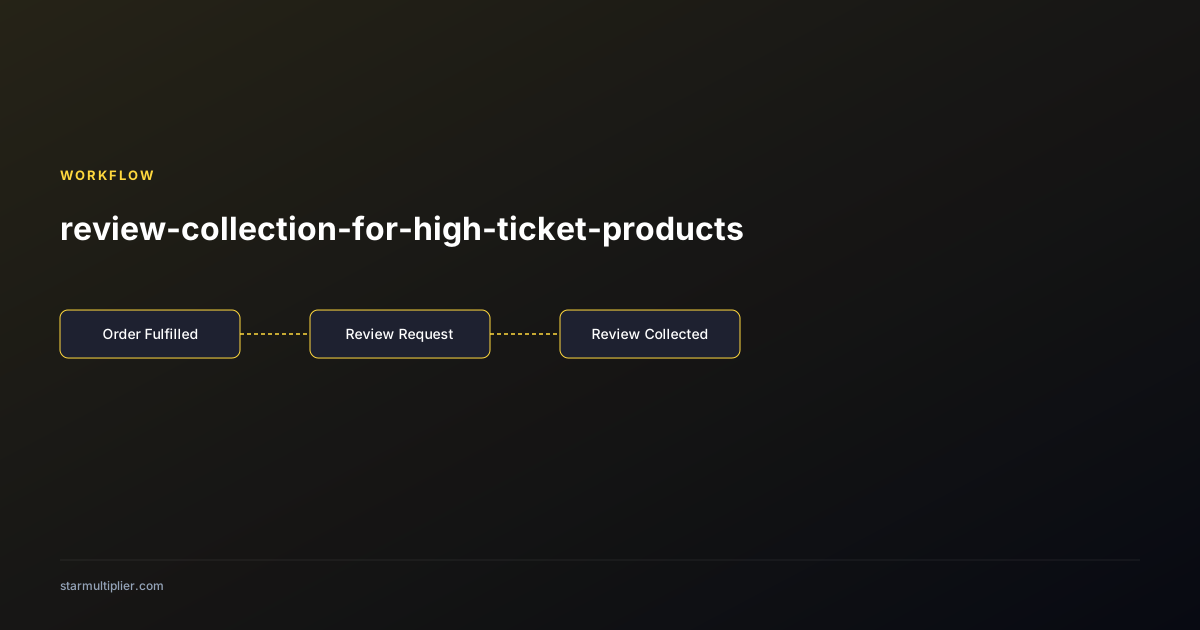
High-ticket products typically have lower sales velocity than lower-priced products, which means review accumulation is naturally slower. A product that sells 5 units per month accumulates reviews much slower than one that sells 100 units per month even with an identical response rate. This makes the review collection efficiency for each individual sale more critical for high-ticket products than for volume products: every sale that does not produce a review request, or every request that does not produce a review, has a larger proportional impact on the product's social proof development. Ensure your review collection workflow has zero gaps for high-ticket products — every fulfilled order should trigger a review request, with no exceptions for order size or customer segment. Track review accumulation per product monthly for high-ticket items and flag any products that are significantly below the rate that would produce adequate social proof within a reasonable timeline. Identify and address the cause of below-expected accumulation rather than accepting slow review velocity as inevitable for high-ticket categories.
How high-ticket product reviews should look on your product pages
Reviews for high-ticket products should be displayed in a way that facilitates the detailed evaluation that high-consideration buyers require. Length matters more for high-ticket reviews than for low-ticket reviews because detailed reviews answer more of the specific questions that high-consideration buyers bring to the product page. Configure your review display to show reviews in full rather than truncated for high-ticket products, or at minimum to expand reviews with a single click rather than requiring navigation away from the product page. Display reviews by helpfulness (upvoted by readers) rather than by recency as the default sort for high-ticket products, because the most thorough, specific reviews are typically more useful to high-consideration buyers than the most recent ones. If your review platform supports it, display verification badges that confirm reviewers purchased the product, because purchase verification is particularly important for high-ticket products where the stakes of fake or non-purchaser reviews are highest.
Want to see where your review workflow is leaking opportunities? Start with a StarMultiplier review audit.
Responding to reviews on high-ticket products to amplify trust
Responding to reviews on high-ticket product pages has a larger conversion impact than responding on lower-ticket pages because potential buyers investing $300 or more in a product are particularly attentive to how the brand treats its customers publicly. A brand response to a positive review on a $400 product page that acknowledges specific details the customer mentioned — 'Thank you for noting the precision of the assembly process, [Name] — this is something our manufacturing team works hard to achieve' — creates a impression of a brand that is genuinely engaged with its products and customers that is highly persuasive to a subsequent $400-consideration buyer. A brand response to a critical review on a high-ticket product page that acknowledges the concern, offers a specific resolution, and maintains a professional tone despite any frustration in the review content demonstrates the kind of brand maturity and customer commitment that high-consideration buyers find reassuring about a potential purchase at this price point.
High-ticket product review programs with a concierge approach
High-ticket products — those at or above $300 to $500 where purchase decisions involve significant deliberation — benefit from a concierge review collection approach that treats the review request as an extension of the premium customer service the purchase itself warranted. A concierge review request comes from a named team member, not a generic brand address, and references specific details about the customer's purchase that signal genuine awareness rather than automated processing. For extremely high-ticket items ($1,000+), a personal phone or email follow-up from a customer success team member — separate from the automated review request — creates the human connection that these high-value customers expect from a brand they trusted with a significant purchase. During this personal follow-up, the team member can address any concerns, confirm satisfaction, and naturally invite the customer to share their experience publicly if they are willing. This concierge approach produces significantly higher review response rates for high-ticket customers than standard automated outreach because the contact level matches the relationship expectations that customers at this price point bring to their purchase decision.
Photographing high-ticket product reviews: encouraging visual content
Customer-submitted photographs in reviews of high-ticket products provide particularly persuasive social proof because they show the product in real-world use by customers who spent significant money on it — evidence that high-consideration buyers find compelling precisely because the stakes of the photographer's purchase decision were high. Encourage photo submission in high-ticket review requests by explicitly inviting customers to share how the product looks in their context: 'If you have a moment, we would love to see a photo of [Product] in your space/setup/life — feel free to include one with your review.' Photo-inclusive review requests for high-ticket products have meaningfully higher photo submission rates than standard photo invitations because high-ticket buyers are more invested in their purchase and more likely to have documented the product experience independently. Display customer photos prominently in the review section of high-ticket product pages, because visual proof from real customers making real investment decisions is the highest-credibility form of social proof available to high-consideration buyers evaluating your most expensive products.
Video review collection for high-ticket products
Video reviews for high-ticket products carry disproportionate persuasive power because they demonstrate the product in authentic use at the scale and quality that justifies the price point in a way that text reviews and still photos cannot replicate. A 60-second customer video showing the product in their actual environment, discussing what they were considering before purchasing and how the product has performed since, provides prospective buyers with the most realistic preview of the ownership experience available from any source. Invite video review submission explicitly in high-ticket product review requests: 'We would love to see [Product] in your home/setup — if you're open to recording a quick 60-second video review, you can upload it directly through this link.' Provide clear instructions for submission (file format, maximum length, how to upload) and acknowledge receipt with a personal thank-you email. Display approved video reviews prominently on the product page, above the text review section if your platform supports it, because prospective buyers will watch video before reading text for high-consideration purchases.
Checklist
- Extend timing window to 14-21 days for high-ticket products
- Write product-specific review request templates that reflect the purchase significance
- Include prominent customer service contact in review requests for high-ticket products
- Track review accumulation per product monthly and flag underperforming items
- Configure review display to show full review text without truncation on high-ticket pages
- Prioritize review responses on high-ticket product pages
- Verify that all high-ticket products have zero workflow gaps in review collection