Review Collection for Subscription Ecommerce: Managing Recurring Customer Outreach
Subscription ecommerce brands face unique review collection challenges. Learn how to manage review requests for recurring customers without over-contacting them.

Quick answer
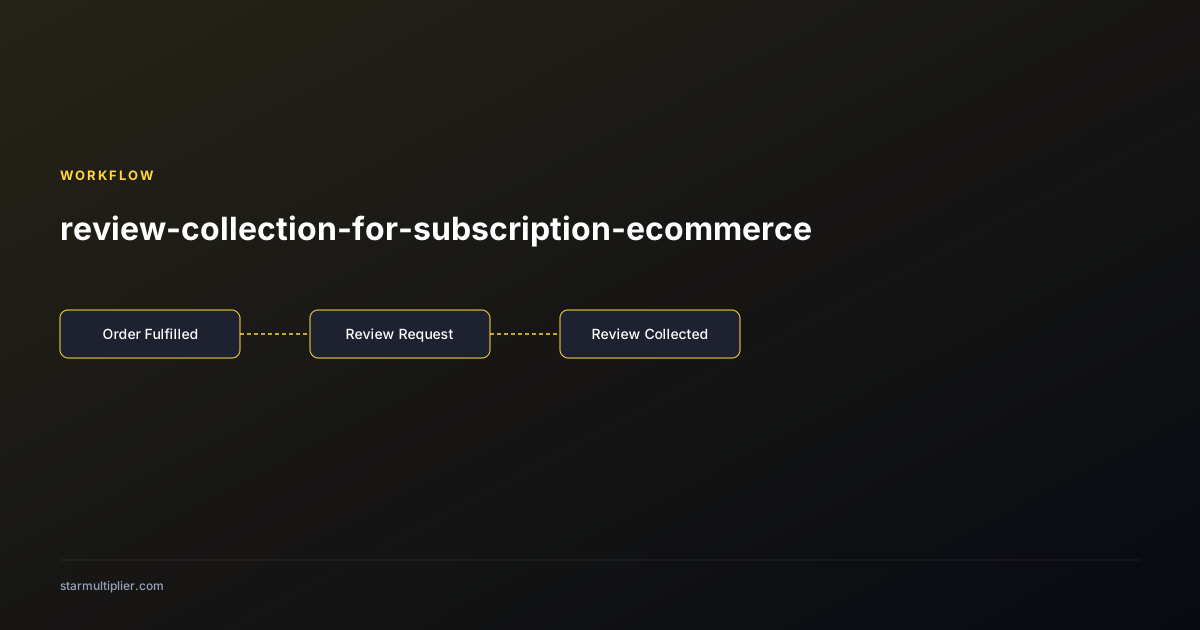
For subscription ecommerce, send review requests on the first delivery and again at the 3 to 6 month mark to capture long-term experience feedback. Do not send review requests on every recurring delivery — this creates review request fatigue and damages the subscriber relationship.
The unique review collection challenges of subscription ecommerce
Subscription ecommerce brands — subscription boxes, consumable replenishment subscriptions, software-as-a-subscription product services — face review collection challenges that do not apply to standard one-time-purchase ecommerce. The most significant challenge is frequency management: a customer who subscribes monthly receives 12 orders per year, and a standard review request workflow that fires on every order would contact them 12 times per year for the same product. This contact frequency is excessive by any reasonable standard and would produce high unsubscribe rates, subscriber dissatisfaction, and damaged subscription retention — the opposite of the review collection goal. The secondary challenge is that subscription customer reviews evolve over time: a review from a subscriber's first delivery captures initial impressions, while a review from their sixth delivery captures sustained product quality and service experience that is more valuable for subscriber acquisition but requires a longer timeline to collect. A subscription review collection strategy must balance review volume goals against subscriber relationship preservation through carefully considered frequency rules.
First delivery review collection: capturing initial impressions
The first delivery review request is the most important single outreach in a subscription customer's review journey because it captures first impressions from the customer perspective that is closest to the perspective of a prospective subscriber who has not yet tried the product. First delivery reviews often mention the unboxing experience, the quality relative to initial expectations, and the value perception — exactly the dimensions that prospective subscribers evaluate when deciding whether to subscribe. Configure a review request for subscription customers triggered by their first delivery, using a first-time-buyer-style template that acknowledges this is their initial experience with your subscription and invites impressions across multiple dimensions (product quality, packaging, value for money, initial satisfaction). Set the timing delay for first delivery reviews to be consistent with your standard product timing — 7 to 10 days after the first fulfillment is typically appropriate. After this first delivery review request, suppress review requests for the next several delivery cycles.
Long-term experience reviews: capturing the sustained subscriber perspective
Long-term experience reviews from subscribers who have been receiving deliveries for 3 to 6 or more months are highly persuasive to prospective subscribers because they demonstrate sustained satisfaction over time rather than just initial enthusiasm. A new subscriber who received 6 deliveries and is still subscribing has made an implicit endorsement of the product that is more credible than a 30-day first impression. Request long-term experience reviews from subscribers at the 3 to 6 month mark (delivery cycle 3 to 6) with a template that specifically asks about sustained experience: 'You have been a subscriber for [X months] now — we would love to hear how [Product] has been fitting into your routine over time. Your feedback is especially valuable for helping other people who are considering subscribing understand what long-term subscribers experience.' This framing positions the long-term review request as an invitation for a uniquely valuable perspective rather than just another review request.
Building subscriber review collection cadence rules
The subscriber review collection cadence defines which delivery cycles trigger a review request and which do not. A reasonable baseline cadence for most subscription products is: delivery 1 (first delivery review), delivery 6 (6-month experience review), delivery 12 (one-year anniversary review), and annual reviews thereafter. This cadence contacts subscribers 3 times in their first year and annually after that — frequent enough to capture meaningful review milestones without overwhelming subscribers with repeated requests for the same recurring product. Implement cadence rules in your review collection platform using subscription delivery count or subscription age attributes to trigger outreach only at the appropriate milestones. If your platform cannot support delivery-count-based triggering natively, use subscription age (first delivery, 6 months post-start, 12 months post-start) as a proxy that approximates the same cadence. Test your cadence implementation by checking that long-time subscribers in your platform history received the correct number of review requests based on their tenure.
Using subscriber review data to improve subscription retention
Review data from subscription customers is more valuable for retention management than review data from one-time buyers because subscription reviews reveal satisfaction trajectory over time. A subscriber whose reviews are consistently positive across multiple review touchpoints is a highly satisfied, low-churn-risk subscriber. A subscriber whose first delivery review was positive but whose 6-month review is negative or not submitted is showing signals of declining satisfaction that correlate with elevated churn risk. Build a practice of cross-referencing subscription review data with churn data monthly: calculate the churn rate for subscribers who left positive reviews at each review milestone versus those who did not submit reviews or submitted negative reviews. If subscribers who reviewed positively at the 6-month milestone have significantly lower 3-month post-review churn rates than those who did not review, the review engagement itself may be contributing to retention through the act of committing a positive public statement about the brand.
Managing subscriber review requests during product or curation changes
Subscription box brands that change their product curation periodically — as is typical for seasonal curation, themed box changes, or product mix evolution — face an additional review collection consideration: reviews from previous curation periods may not accurately represent the current subscriber experience. When a significant curation change occurs, consider triggering a special review request to current subscribers that acknowledges the change and invites feedback on the new direction: 'We have refreshed our [Season/Theme] curation for this month's box — we would love to hear your thoughts on the new products we have included.' This approach collects timely, relevant reviews at the moment of change rather than waiting for the standard cadence to produce fresh feedback, which is particularly important when a significant portion of existing product page reviews reflect a curation that no longer exists.
Want to see where your review workflow is leaking opportunities? Start with a StarMultiplier review audit.
Handling pause and skip events in subscription review collection
Subscription ecommerce platforms allow customers to pause or skip delivery cycles, which creates complexity in review collection cadence tracking. A subscriber who pauses for two months and then resumes has an effective subscription age that differs from their calendar tenure. Review collection cadence rules based on calendar time rather than delivery count will misjudge where this subscriber is in their review journey and may send an out-of-sequence review request. For example, a subscriber who should be receiving their 3-month experience review request may instead receive it at month 5 of calendar time due to a two-month pause. Configure your review cadence tracking on delivery count rather than calendar time to correctly sequence review requests regardless of pause or skip behavior. If your subscription platform does not provide delivery count data directly, build a calculation based on order count in your review platform — the number of fulfilled subscription orders for a specific customer is a reliable proxy for delivery count regardless of pauses or skips in the subscription schedule.
Building a subscriber review community around long-term feedback
Long-term subscribers who leave multiple reviews over their subscription tenure represent a small but highly valuable subset of your review base: customers who have demonstrated sustained satisfaction and ongoing engagement with your brand's post-purchase communications. These prolific reviewers are natural candidates for deeper community engagement — beta testing new subscription curation, providing early feedback on potential product additions, or contributing to subscriber success stories (with explicit permission) that support acquisition marketing. Building a subscriber review community does not require dedicated community infrastructure: a simple practice of identifying customers who have submitted three or more reviews over their subscription tenure and personally reaching out to thank them for their ongoing feedback creates a VIP engagement that most brands miss entirely. These customers are typically already your most satisfied and most loyal subscribers — acknowledging their contribution to the brand's review profile deepens the relationship at a moment when the subscription retention benefit of that deepened relationship is most valuable.
Connecting subscriber review data to subscription churn prediction
Subscriber review data, when connected to churn prediction models, can improve churn prediction accuracy by adding a behavioral engagement signal that purchase frequency data alone does not capture. A subscriber who purchases consistently (monthly on time) but has not engaged with any review request communications over the past six months is showing lower brand engagement than their purchase frequency suggests, and may be at higher churn risk than their purchase pattern indicates. A subscriber who reviewed enthusiastically at months 1, 3, and 6 but has not reviewed since month 6 may have experienced a satisfaction decline that has not yet manifested in cancellation behavior. Incorporating review request engagement — opens, clicks, submissions — as a feature in churn prediction models alongside purchase frequency, customer service interactions, and subscription modification history creates a more complete picture of subscriber health. Share review engagement signals with your retention team monthly so they can include them in their proactive outreach targeting for subscribers showing composite warning signs across multiple engagement dimensions.
Subscriber reviews as content for subscription acquisition marketing
Subscriber reviews from customers who have been with your brand for multiple delivery cycles are the highest-credibility acquisition marketing content available to subscription ecommerce brands, because they represent sustained satisfaction rather than initial enthusiasm. A subscriber who is 10 months into a monthly subscription and writes 'I look forward to this every month — the curation consistently exceeds my expectations and I have discovered several products that have become permanent parts of my routine' is providing a testimonial that speaks directly to the subscription retention questions that prospective subscribers have when evaluating whether to commit to a recurring purchase. With appropriate permission from the reviewer, this type of long-tenure subscriber review is suitable for use in acquisition advertising, subscription landing page testimonials, and email marketing campaigns targeting prospects who are evaluating your subscription. Establish a process for identifying and obtaining permission to use exemplary long-tenure subscriber reviews in marketing contexts — a simple permission request sent directly to the reviewer via email is sufficient, and most satisfied subscribers who have left detailed reviews are willing to have those reviews used in brand marketing.
Review program communication during subscription pause and reactivation
Subscription pause and reactivation events create specific review communication opportunities and risks that a standard subscription review workflow may not handle optimally. A subscriber who pauses their subscription after several deliveries but before receiving a review request is in an ambiguous state: they are still technically a subscriber but have indicated reduced engagement, making a review request during the pause period potentially unwelcome. Suppress review requests for subscribers who have initiated a pause, and resume the review collection workflow when the subscription reactivates. The reactivation event itself is a natural review collection moment: a subscriber who chose to reactivate is demonstrating continued brand preference that makes them a high-probability reviewer. A reactivation review request that acknowledges the subscriber's return — 'Welcome back — we'd love to hear how [Product] has been working for you across your orders so far' — frames the review request as a relationship continuation rather than a new transaction, which may improve response rates among returning subscribers who have accumulated substantial product experience to share.
Checklist
- Configure first-delivery review request for all new subscribers
- Suppress review requests on all delivery cycles between cadence milestones
- Build 6-month and 12-month anniversary review requests into subscription cadence
- Use subscriber-specific template language that acknowledges recurring subscription context
- Cross-reference review submission data with churn data monthly
- Trigger special review requests after significant product or curation changes
- Track long-term subscriber reviews separately from first-delivery reviews in analytics