Review Request Frequency: How Often Should You Ask Customers for Reviews?
Asking for reviews too often damages customer relationships and increases unsubscribes. Learn the right frequency for different customer types and purchase patterns.

Quick answer
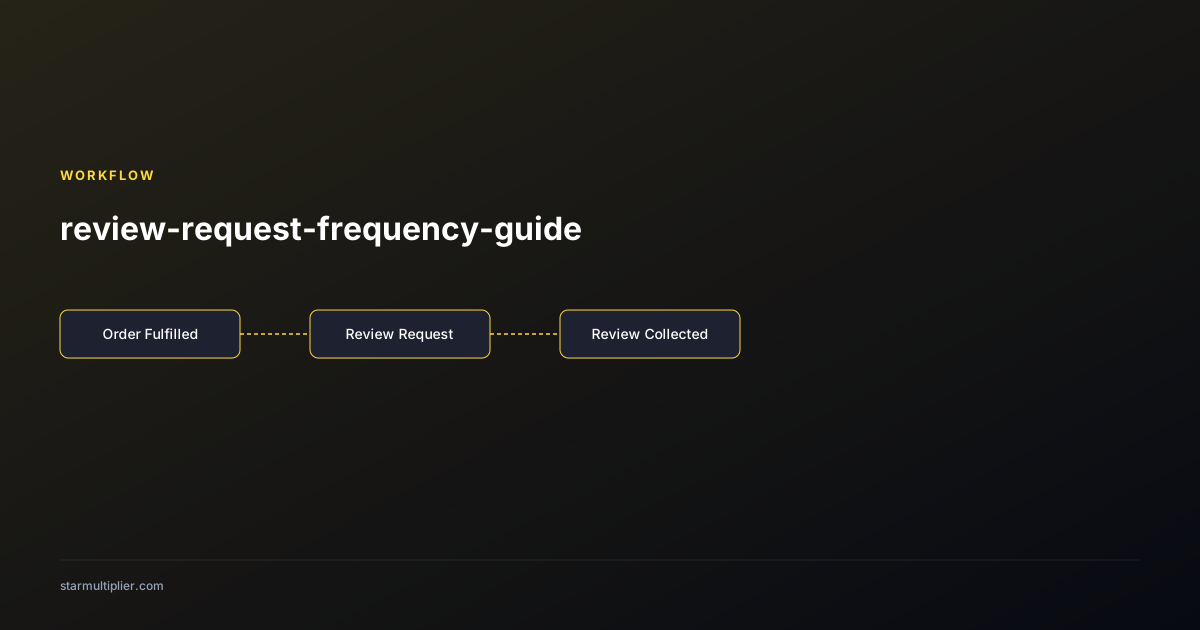
Ask customers for a review once per product purchased, with one follow-up reminder if they do not respond to the initial request. Do not send review requests on every order for customers who purchase the same product repeatedly.
Finding the right review request frequency for your business
Review request frequency refers to how often you ask a specific customer for reviews across their purchase history with your brand. Getting this frequency wrong in either direction has costs. Too infrequent: you miss review collection opportunities, reducing the rate at which your social proof accumulates and leaving your product pages underreviewed relative to their traffic and sales volume. Too frequent: you create review request fatigue, increase unsubscribe rates from customers who feel over-contacted, and risk damaging the customer relationship that your brand has worked to build. The right frequency is the highest rate that does not produce measurable negative effects on customer relationships — measured by unsubscribe rate, complaint rate, and the review sentiment of customers who have received multiple review requests versus those who have received fewer. For most one-time-purchase ecommerce businesses, this equilibrium is one review request per product purchased, with one follow-up reminder. For subscription ecommerce businesses, the equilibrium is significantly lower due to the frequency of recurring deliveries.
One review request per product: the standard frequency rule
The standard frequency rule for most ecommerce businesses is one review request per product per customer — if a customer purchased Product A and Product B in separate orders, they can receive review requests for both products. If a customer purchased Product A twice in separate orders, they should receive a review request for only one of those purchases, not for both. Sending duplicate review requests for the same product to the same customer produces no additional social proof (the customer has only one experience with the product to review) while doubling the contact load for that product. Implement this rule by configuring product-level suppression in your review collection workflow: if a customer has already submitted a review for a product or has already received a review request for that product, suppress future review requests for that same product regardless of how many additional times they purchase it. This suppression preserves your ability to send review requests for new products the customer purchases while preventing duplication for repeat purchases of the same product.
Maximum contact frequency: how many total review requests is too many?
Beyond the per-product rule, a maximum contact frequency rule limits how many total review request emails a customer receives in a given time period regardless of how many different products they have purchased. A customer who purchases 8 different products in a month should not receive 8 review request emails plus up to 8 follow-up reminders in the same month — this volume of post-purchase contact would reasonably feel excessive regardless of each individual product being a legitimate review request opportunity. Set a maximum contact frequency of 2 to 3 total review request contacts per 30-day period per customer, prioritizing the most recent or highest-value purchases when the rule limits the number of requests that can be sent. This maximum frequency rule protects the customer relationship for high-frequency buyers who are also the customers with the highest lifetime value — exactly the customers whose relationship is most worth protecting.
Frequency adjustments for different customer lifecycle stages
Review request frequency should vary across the customer lifecycle based on the relationship stage and the customer's demonstrated review engagement history. New customers who have made their first purchase should receive a review request at the standard timing and should not receive a second review request (for a different product) until after the first review cycle has completed — giving the customer time to engage with the first request before receiving a second one. Loyal repeat customers who have submitted reviews before have demonstrated review engagement and can be contacted at a slightly higher frequency, since their history indicates they find value in leaving reviews and are less likely to experience review requests as intrusive. Customers who have consistently not responded to review requests across multiple request cycles should be moved to a reduced frequency — one review request per year — rather than continuing to send standard-frequency requests to customers who have demonstrated they will not respond.
Using unsubscribe rate to calibrate your frequency policy
Unsubscribe rate from review request emails is the most direct measurement of whether your contact frequency is exceeding customer tolerance. Monitor unsubscribe rate monthly and compare it against industry benchmarks: a healthy unsubscribe rate for review request emails is typically 0.1 to 0.5 percent per send. An unsubscribe rate above 1 percent suggests the frequency, timing, or content of your review requests is creating friction that leads customers to opt out rather than simply delete the email. If elevated unsubscribes are concentrated among customers who have received multiple review request emails in a 30-day period, the frequency policy is the likely driver. Reduce maximum contact frequency and monitor whether the unsubscribe rate returns to the normal range. If elevated unsubscribes are distributed evenly across all customers regardless of frequency, the content or timing of the review request is more likely to be the driver, and content or timing improvements should be prioritized over frequency reduction.
Want to see where your review workflow is leaking opportunities? Start with a StarMultiplier review audit.
Frequency rules for marketplaces versus direct-to-consumer channels
Brands that sell through both their own direct-to-consumer channel and marketplaces like Amazon face frequency challenges because review requests from multiple channels can aggregate to create a higher total contact frequency than any single channel would produce. A customer who buys your product on Amazon and also on your direct website may receive an Amazon review request (if your marketplace selling includes third-party review request tools) and a DTC channel review request for the same product. From the customer's perspective, this is redundant and potentially frustrating. If you manage both channels, establish a deduplication protocol that checks whether a review request has already been sent for a product-customer combination across all channels before sending a new request. This protocol is complex to implement across disconnected channel systems but is the correct long-term approach for brands where significant customer overlap exists between DTC and marketplace purchase behavior.
Review request frequency and email sender reputation
The frequency with which you send review request emails to your customer list affects your email sender reputation in ways that have consequences beyond the review collection program itself. High unsubscribe rates from review request emails erode the quality of your customer email list and can damage the sender reputation used for promotional emails, transactional emails, and other customer communications that share the same sending domain. If your review request email program produces unsubscribe rates above 1 percent per send, investigate whether frequency is the driver — compare unsubscribe rates for customers who received one review request in the past 90 days against those who received two or more. If higher-frequency recipients show significantly elevated unsubscribe rates, your frequency policy is contributing to list erosion that affects your entire email marketing program, not just review collection. Reducing review request frequency until unsubscribe rates normalize protects both the customer relationship and the email sender reputation that your marketing team depends on for all customer communications.
Frequency policies for high-velocity ecommerce categories
Certain ecommerce categories — flash sale platforms, commodity consumables, daily-deal sites — are characterized by very high customer purchase frequency that creates unusual review request frequency challenges. A customer who purchases from a flash sale platform 15 times per month could theoretically receive 30 review request emails per month (initial request plus follow-up for each purchase) under a naive implementation of standard review collection workflows. This volume would immediately destroy the customer relationship and produce catastrophic unsubscribe rates. For high-velocity categories, implement a maximum monthly contact cap — typically two to four review request emails per customer per month regardless of purchase count — combined with a product-prioritization rule that selects the highest-value or most recently purchased products for review request generation when orders exceed the monthly cap. For customers who purchase the same product repeatedly at high frequency (weekly replenishment buyers, for example), implement a minimum re-request interval of 60 to 90 days for any specific product regardless of how many times it has been purchased in that window.
Communicating your review request frequency policy to customers
Proactively communicating your review request frequency policy to customers who ask — or who express frustration about receiving multiple review requests — demonstrates operational transparency that can convert a potentially negative interaction into a trust-building moment. If a customer contacts you to say they have received too many review requests, respond with a clear explanation of your policy: 'We send one review request per product purchased and one reminder if we do not hear back, with a minimum of [X] days between any contacts. We are sorry if the timing felt frequent and we have noted your preference not to receive further review requests.' This response is accurate (if it reflects your actual policy), demonstrates that your program is governed by a coherent policy rather than arbitrary sends, and resolves the complaint by confirming the future opt-out. Maintaining an accurate and accessible review request frequency policy also protects you if a customer escalates a complaint to a regulatory body — you can demonstrate that your contact frequency is governed by a documented, reasonable policy that was applied correctly in the specific case.
Checklist
- Implement product-level review request suppression to prevent duplicate requests for the same product
- Set a maximum of 2-3 review request contacts per customer per 30-day period
- Reduce frequency for customers who have not responded to multiple review requests
- Monitor unsubscribe rate monthly and investigate rates above 0.5% per send
- Establish deduplication protocol if you sell across both DTC and marketplace channels
- Separate frequency rules for subscription customers from one-time purchase customers
- Review frequency policy quarterly against unsubscribe data and response rate data