Review Request Operations Playbook for Ecommerce Brands
Review Request Operations Playbook for Ecommerce Brands — a practical guide for ecommerce stores. Learn how to build a more effective review collection process with better timing, messaging, and workflow.
Quick answer
A review request operations playbook provides step-by-step guidance for building a repeatable review request system that scales with your order volume. The playbook covers team roles, timing rules, template management, and compliance checks.
What is review request operations playbook?
A review request operations playbook provides step-by-step guidance for building a repeatable review request system that scales with your order volume. The playbook covers team roles, timing rules, template management, compliance checks, and performance monitoring. A documented playbook ensures consistency and makes it easy to train new team members on your review collection process.
Why review request operations playbook matters for ecommerce stores
A playbook transforms review collection from an informal practice into a structured operational process. The documentation creates consistency, reduces errors, and makes the process scalable. When a new team member joins, they can read the playbook and understand exactly how review collection works rather than learning through trial and error.
How to approach review request operations playbook
Develop your playbook by documenting each step of your review collection process in detail. Include timing rules, template versions, compliance checklists, escalation procedures for negative feedback, and performance targets. The level of detail should allow anyone on your team to follow the process without asking clarifying questions.
Assess your current review collection process
Start by reviewing how you currently collect reviews. Are you using automated requests, manual emails, or no structured process at all? Understanding your starting point helps you choose the right improvements.
Define your review collection goals
Set realistic targets based on your order volume. A store processing 100 orders per week might target 10-15 new reviews per week with an optimized request workflow.
Implement and iterate
Choose the right approach for your store size and implement it. Monitor response rates and adjust timing, messaging, and targeting based on performance data.
Step-by-step review request operations playbook framework
First, document your current review collection process from end to end. Second, identify gaps, inconsistencies, and improvement opportunities. Third, define standard timing rules for different customer segments and product types. Fourth, create a template library with version tracking. Fifth, establish a compliance review checklist. Sixth, define escalation procedures for negative feedback or unusual situations. Seventh, set performance targets and monitoring cadence.
Practical examples
A store developed a ten-page review operations playbook that covered everything from request timing rules to response handling procedures. The team reviewed the playbook quarterly and updated it based on performance data and changing requirements. New team members could read the playbook and be productive within their first week. Another store created a simplified one-page version of their playbook as a quick reference guide that team members kept at their desks.
Example for growing stores
A mid-size store processing 300 weekly orders implemented automated review requests and saw review volume increase from 15 to 40 reviews per month within eight weeks.
Example for small stores
A boutique store with 50 weekly orders used targeted template messages for first-time buyers and repeat customers separately, improving response rates by 25 percent.
Common mistakes to avoid
One mistake is creating a playbook and never updating it. Review operations evolve as your store grows, and the playbook should evolve with it. Another mistake is making the playbook so detailed that it becomes difficult to use. Balance comprehensiveness with usability by including both detailed procedures and quick-reference summaries.
Inconsistent timing
Sending requests at random intervals confuses customers and reduces response rates. Consistent timing based on delivery windows produces better results.
Generic messaging
Using the same message for every customer misses the opportunity to tailor requests by customer segment and purchase history.
review request operations playbook checklist
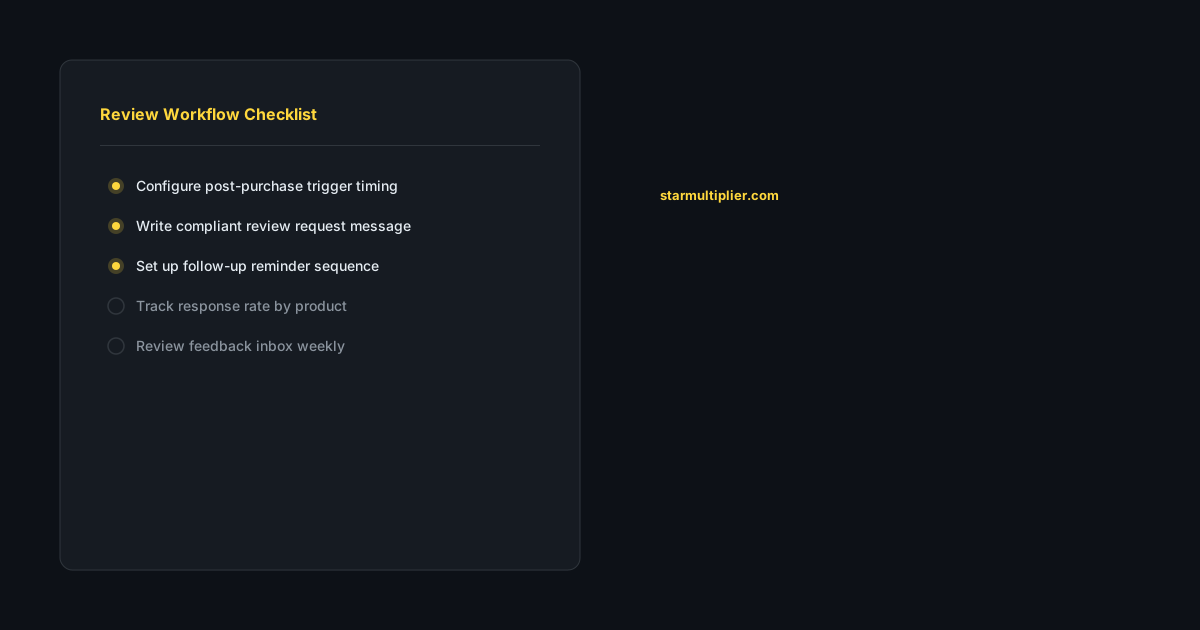
Document every step of your review collection process in enough detail for a new team member to follow. Include timing rules, template versions, and compliance checklists. Review and update your playbook quarterly based on performance data and operational changes. Create both a detailed version and a quick-reference summary.
How StarMultiplier helps with review request operations playbook
StarMultiplier helps teams implement the automated request systems described in their operations playbook. The platform handles timing, delivery, and tracking according to your documented rules, making the playbook actionable rather than aspirational. Teams using StarMultiplier find that the platform's automated workflows align well with their documented operational standards.
Want to see where your review workflow is leaking opportunities? Start with a StarMultiplier review audit.
What a review request operations playbook includes
A review request operations playbook is a documented reference that enables any qualified team member to operate and maintain the review collection workflow consistently. The playbook documents the current workflow configuration in enough detail that someone unfamiliar with the original setup decisions can understand what is configured, why it is configured that way, and how to maintain it going forward. Core sections of the playbook include a workflow overview that maps the full sequence from order fulfillment to review completion, a configuration reference that documents every setting in your review request platform, a template library that includes all current templates with notes on when each is used and when it was last updated, a suppression and compliance section that explains what suppression rules exist and why, and a monitoring and improvement section that describes the metrics to track, the cadence for tracking them, and the process for investigating and addressing performance changes. The playbook should be a living document that is updated whenever the workflow configuration changes, rather than a static reference that becomes outdated as the workflow evolves. Assign a specific team member as the owner of the playbook with responsibility for keeping it current.
Building review request operations playbook sections for your team
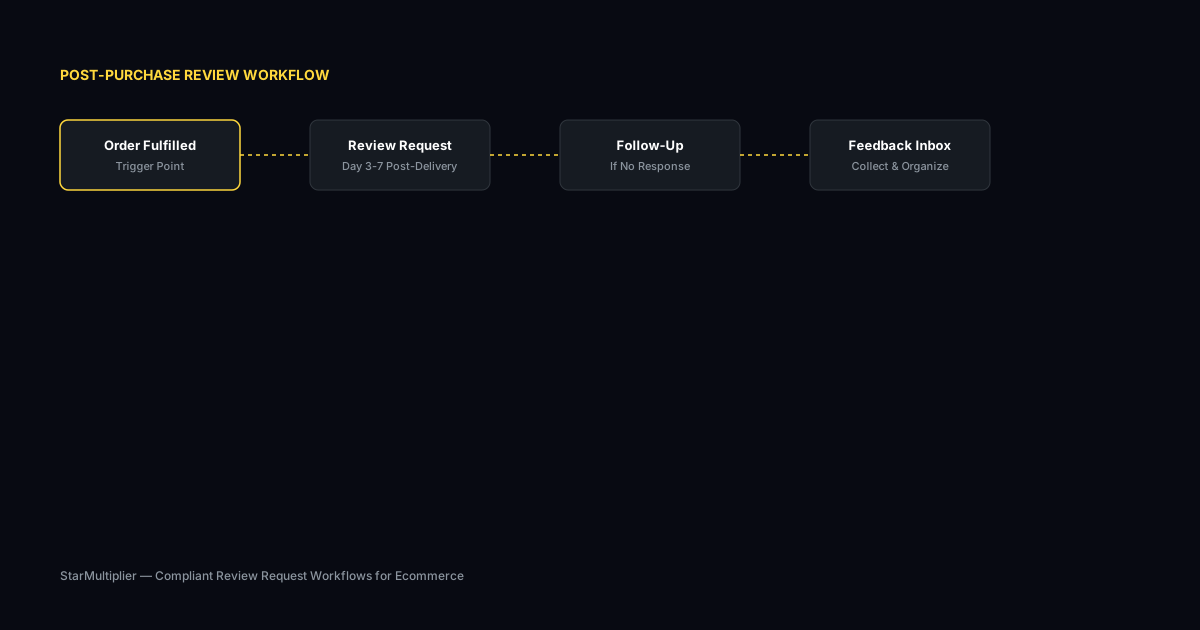
Building each section of a review request operations playbook requires balancing comprehensiveness with usability. A playbook that is too detailed becomes too long to read and maintain; one that is too brief leaves gaps that cause confusion when team members encounter edge cases. The workflow overview section should be a visual map or simple flowchart that shows the sequence of events from order fulfillment trigger to review completion, with notes on timing, branching points, and suppression conditions. This section should be understandable to a new team member in five minutes without requiring them to read the detailed configuration sections. The configuration reference section should document every setting in your review request platform: what the setting is, what it is currently configured to, and why it is configured that way. Include a note about any setting that should not be changed without a compliance review. The template library section should include the full text of every current template, a description of which customers receive it, when it was last reviewed, and what response rate it achieves compared to your baseline. The monitoring section should include a checklist for the monthly review cadence, a list of the metrics to check, and a decision tree for what to do when specific metrics are outside normal range.
Maintaining and evolving your review request operations playbook
A review request operations playbook only provides its intended value if it is maintained and used consistently. Establish a quarterly playbook review as a standard operations activity: read through the full playbook, verify that every configuration description still matches the actual current setup, update any sections that describe outdated processes or settings, and add documentation for any new workflow elements that have been added since the last review. Treat the playbook update as a compliance check as well as a documentation task: each quarterly review is an opportunity to verify that the current workflow remains aligned with the current policies of all review platforms you use. When making changes to your review request workflow — updating a template, adjusting timing rules, adding a new customer segment — update the relevant playbook section at the same time rather than deferring the documentation. Simultaneous updates are much easier to maintain than retrospective documentation of changes that were made months earlier. Use the playbook actively in team meetings and training, referring to it when discussing workflow decisions rather than relying on institutional memory. When the playbook is used as an active tool rather than a filed document, it remains current and useful rather than drifting into obsolescence.
Review request operations playbook template structure
Use this template structure to build a review request operations playbook for your team. Section one: overview — a one-page summary of your review collection goals, the platforms you collect reviews on, the customer segments you target, and the key performance metrics you track. Section two: workflow documentation — a step-by-step description of your complete review request workflow from order fulfillment trigger to review completion, including all timing rules, segmentation logic, template assignments, and suppression conditions. Section three: platform configuration reference — a complete record of every setting in your review request platform with current values and explanatory notes. Section four: template library — every active template with full text, audience description, last update date, and current performance metrics. Section five: monitoring procedures — a weekly and monthly checklist of what to check, what thresholds indicate a problem, and what steps to take when a problem is identified. Section six: compliance documentation — a record of last policy review for each review platform, a summary of current compliance requirements, and any compliance decisions made about specific workflow elements. Section seven: vendor contacts — platform support contacts, account details, and escalation paths for different types of issues. Update each section quarterly or whenever significant workflow changes are made.
Using your review request operations playbook during team transitions
A review request operations playbook provides its most critical value during team transitions when the primary owner of the review workflow changes roles, leaves the organization, or takes extended leave. Without documentation, a team transition creates an immediate risk of workflow degradation: the incoming team member does not know what the workflow configuration is, why it was configured that way, what the current performance benchmarks are, or what maintenance tasks need to happen on what schedule. A well-maintained playbook allows a new team member to understand the complete review operations function in a few hours of reading rather than through weeks of tribal knowledge transfer. Conduct a formal playbook handoff when transitioning review operations ownership: walk the incoming team member through each section of the playbook, explain any aspects that require contextual knowledge beyond what is written, and have the incoming team member complete the first monthly monitoring checklist while the outgoing owner is still available to answer questions. Schedule a follow-up check-in two to four weeks after the handoff to address any questions that have arisen from real-world operation of the workflow rather than from reading the documentation in the abstract.
Annual review of your review request operations playbook
Conducting an annual review of your review request operations playbook ensures the documentation remains accurate and actionable rather than drifting away from the live configuration over time. Schedule the annual playbook review as a calendar commitment at the same time each year, with a defined owner and a four-hour time block for a thorough review. During the annual review, work through each playbook section and verify it accurately describes current reality: are the platform configuration settings documented in section three still current? Have any templates changed since the last update to the template library? Are the monitoring thresholds in the procedures section still calibrated to current performance baselines? Have any vendor contacts or support processes changed? Is the compliance documentation current with the latest versions of each platform's review policies? After the review, update every section that no longer accurately reflects current operations and add a version date to the playbook so future readers know when the last full review occurred. Share the updated playbook with all team members who have review operations responsibilities so everyone is working from the same current understanding of the workflow.