Product Review Follow-Up Sequence for Better Customer Feedback
product review follow up sequence — a practical guide for ecommerce stores. Learn how to build a more effective review collection process with better timing, messaging, and workflow.
Quick answer
A product review follow up sequence helps stores collect more feedback without sending excessive messages. The key is spacing each touchpoint appropriately and making each message feel like a natural continuation rather than a repeated ask.
What is product review follow up sequence?
Product Review Follow-Up Sequence for Better Customer Feedback helps stores turn a one-time review request into a complete post-purchase feedback loop. The key is understanding that different customers need different follow-up approaches based on their purchase history, product type, and engagement level.
Why product review follow up sequence matters for ecommerce stores
A product review follow up sequence matters because not every customer will respond to your first request. A thoughtful follow-up increases your overall response rate without making customers feel pressured or annoyed. The right follow-up sequence respects the customer's time while giving them a convenient opportunity to share feedback.
How to approach product review follow up sequence
The best product review follow up sequence tailors follow-up timing and messaging based on customer behavior. If a customer opened the first email but did not click through, the follow-up can reference the product directly. If they did not open the first email, the follow-up should try a different subject line approach.
Assess your current review collection process
Start by reviewing how you currently collect reviews. Are you using automated requests, manual emails, or no structured process at all? Understanding your starting point helps you choose the right improvements.
Define your review collection goals
Set realistic targets based on your order volume. A store processing 100 orders per week might target 10-15 new reviews per week with an optimized request workflow.
Implement and iterate
Choose the right approach for your store size and implement it. Monitor response rates and adjust timing, messaging, and targeting based on performance data.
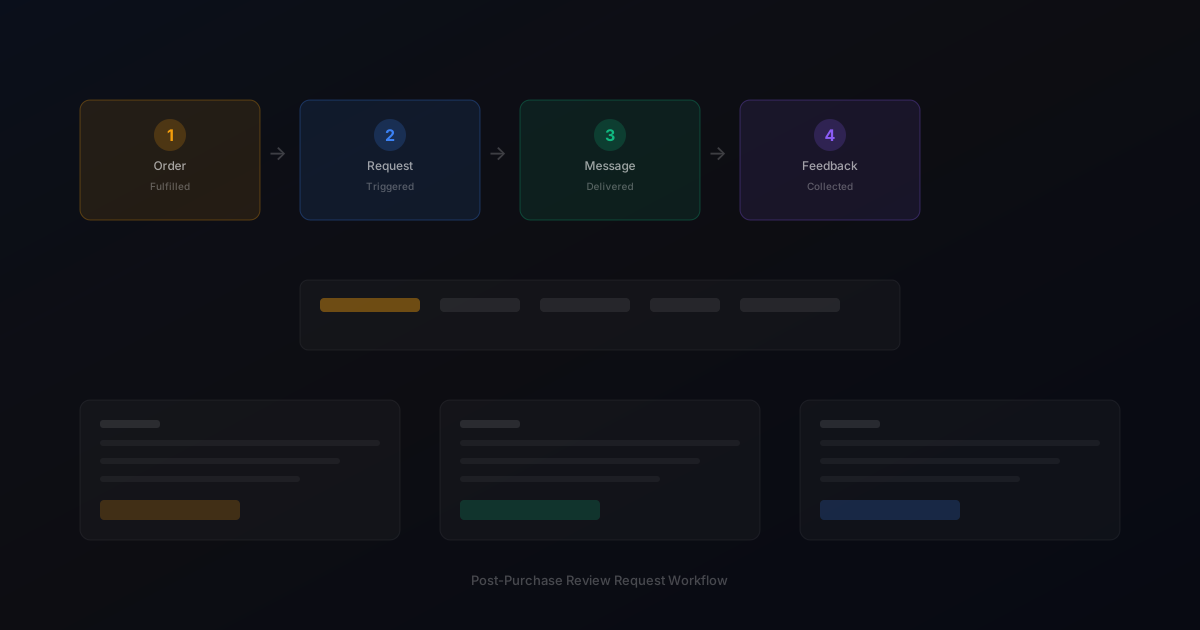
Step-by-step product review follow up sequence framework
1. Send primary request 3-5 days after delivery. 2. Wait 5-7 days for response window. 3. Send first follow-up with different subject line and shorter message body. 4. Wait another 5-7 days. 5. Optional: Send second follow-up only to customers who opened previous messages but did not convert. 6. Automatically suppress follow-ups for customers who have already left a review.
Practical examples
A pet supplies store found that customers who opened the primary request but did not click through responded well to a follow-up that included a photo of the product in use. The visual reminder prompted an additional 12 percent of engaged customers to leave a review.
Example for growing stores
A mid-size store processing 300 weekly orders implemented automated review requests and saw review volume increase from 15 to 40 reviews per month within eight weeks.
Example for small stores
A boutique store with 50 weekly orders used targeted template messages for first-time buyers and repeat customers separately, improving response rates by 25 percent.
Common mistakes to avoid
The most common mistake is using the same subject line and message structure for the follow-up as the original request. Customers who saw the first email will recognize the repeat and may ignore it. Another mistake is sending follow-ups to customers who have already left a review, which creates a poor experience.
Inconsistent timing
Sending requests at random intervals confuses customers and reduces response rates. Consistent timing based on delivery windows produces better results.
Generic messaging
Using the same message for every customer misses the opportunity to tailor requests by customer segment and purchase history.
product review follow up sequence checklist
Write a primary request and at least one follow-up with different messaging. Space messages 5-7 days apart. Use a different subject line for the follow-up. Automatically suppress customers who have already reviewed. Track open and click rates for each step.
How StarMultiplier helps with product review follow up sequence
StarMultiplier handles the complexity of a product review follow up sequence by automating follow-up timing, message variation, and response suppression. The platform ensures customers never receive a follow-up after they have already left feedback, creating a cleaner post-purchase experience.
Want to see where your review workflow is leaking opportunities? Start with a StarMultiplier review audit.
Designing a follow-up sequence that converts non-responders without alienating them
A product review follow-up sequence is a planned series of touchpoints designed to recapture customers who received your initial review request but did not complete a review. The key design principle is restraint: a follow-up sequence that sends too many contacts, too quickly, creates a worse customer experience than no follow-up at all. The standard structure for an ecommerce product review follow-up sequence includes two contacts — the initial request and one follow-up reminder — separated by 5 to 7 days. Some product categories or customer segments benefit from a slightly longer interval between contacts, particularly for high-consideration products where customers may take longer to form a settled opinion. Beyond two contacts, the risk of creating a negative experience for customers who have clearly decided not to review outweighs the incremental response rate improvement from additional reminders. The follow-up email should be meaningfully shorter than the original request: customers who did not respond to the first email do not need the full context repeated, and a shorter, more direct reminder has a better chance of capturing their attention during a busy moment.
Suppression rules that protect your sender reputation and customer relationships
Suppression rules are the logic your review follow-up sequence uses to determine which customers should not receive the next contact in the sequence. Without suppression rules, your sequence will send reminder emails to customers who have already reviewed, customers who have opted out of review communications, customers who have reported a problem with their order, and customers who clicked through to the review platform but did not complete a review. Each of these scenarios requires a different suppression approach. Customers who have already reviewed should be suppressed immediately from all further review request contacts. Most review platforms can provide a webhook or daily feed of completed reviews that your sequence can use to update the suppression list in near-real time. Customers who opt out through an email unsubscribe link must be suppressed permanently from all future review request contacts and should not receive review requests for any future orders. Customers who reported a problem should have their follow-up paused until the issue is resolved, at which point a decision can be made about whether a review request is appropriate. Customers who clicked through but did not complete a review can receive the follow-up reminder because they expressed interest but encountered friction at the review platform itself.
Measuring and improving your product review follow-up sequence
Measuring the effectiveness of your product review follow-up sequence requires tracking metrics at each stage: how many customers receive the initial request, how many open it, how many click through to the review platform, and how many complete a review. The follow-up reminder adds a second layer: how many customers who did not respond to the initial request open the reminder, and how many of those complete a review. Comparing these metrics reveals where your sequence is losing customers. If the initial request has strong open rates but weak click-through, the email body and call to action need improvement. If click-through is strong but completion is low, the friction is at the review platform itself. If the reminder has much lower open rates than the initial request, your subject line differentiation between the two is insufficient. Improve one variable at a time so you can attribute changes in metrics to specific modifications. Test different reminder timing intervals to see whether 5, 7, or 10 days after the initial request produces the best incremental response rate for your specific customer base. Over time, these improvements compound: a 20 percent improvement in reminder open rate and a 15 percent improvement in completion rate combine to meaningfully increase your total review volume without requiring any change to your initial request or your product quality.
Checklist for evaluating your current product review follow-up sequence
Use this checklist to evaluate whether your current product review follow-up sequence is configured correctly and performing optimally. Trigger verification: is the initial review request firing based on order fulfillment date plus a delivery window delay, rather than immediately after checkout? Template personalization: do both the initial request and the follow-up reminder include the customer's name and the specific product purchased? Follow-up timing: is the reminder sending 5 to 7 days after the initial request, not 1 to 2 days (too soon) or 14+ days (too late)? Suppression logic: is the follow-up suppressed for customers who clicked the review link in the initial request, who completed a review, who opted out, or whose order was returned? Follow-up limit: is there exactly one follow-up reminder per review request sequence rather than multiple reminders? Separate subject line: does the follow-up reminder use a different subject line than the initial request so it appears as a distinct message rather than a duplicate? Response rate tracking: are you tracking the response rates of initial requests and follow-up reminders separately so you can measure the incremental contribution of the follow-up sequence? Any 'no' in this checklist indicates a configuration gap worth fixing.
How follow-up sequences change performance for different customer segments
Follow-up reminder performance varies significantly across customer segments, and understanding these differences helps you configure segment-specific follow-up rules rather than using a single approach for all customers. Repeat customers typically respond to follow-up reminders at higher rates than first-time customers because they have an established relationship with your brand and are more likely to feel motivated to engage with post-purchase communications. First-time customers who received a positive initial experience respond to follow-up reminders well; those who had a problem and have not yet reached out to support are less likely to respond positively to a follow-up and may benefit from a sequence that pauses follow-up until any support interactions are resolved. High-value order customers often respond at higher rates to follow-up reminders that acknowledge the significance of their purchase and invite the specific, detailed feedback that high-consideration purchases warrant. Customers who opened the initial review request but did not click through are the highest-value follow-up target: they engaged with the first message and simply need a more compelling call to action in the reminder to complete the review.
Managing follow-up sequence expectations with your ecommerce customers
Managing customer expectations about post-purchase communication frequency is an underappreciated dimension of follow-up sequence design. Customers who feel they are receiving too many follow-up emails from a brand — even for legitimate purposes like review requests — form a negative impression that affects both their review likelihood and their repurchase likelihood. A single initial review request followed by one reminder, with appropriate spacing between them, stays within the range that most customers consider acceptable post-purchase communication. Communicate your post-purchase communication approach in your order confirmation or post-purchase email so customers know what to expect: 'We will follow up a couple of times to make sure everything arrived as expected and to invite your feedback.' This transparent expectation-setting reduces the likelihood that subsequent review request emails are perceived as unexpected or excessive. Make unsubscribing from review request emails straightforward, and honor unsubscribes permanently rather than resetting them after a subsequent purchase. Customers who find it difficult to opt out of review communications are more likely to mark emails as spam, which damages your sending reputation and reduces deliverability for all customers.