Ecommerce Agency Review Management: How to Organize Client Review Workflows
Ecommerce Agency Review Management: How to Organize Client Review Workflows — a practical guide for ecommerce stores. Learn how to build a more effective review collection process with better timing, messaging, and workflow.
Quick answer
Ecommerce agency review management covers how agencies organize review request workflows, feedback collection, and performance reporting for multiple clients. A structured approach ensures consistency and helps agencies demonstrate ROI.
What is ecommerce agency review management?
Ecommerce agency review management covers how agencies organize review request workflows, feedback collection, and performance reporting for multiple clients. A structured management approach ensures consistency across client accounts and helps agencies demonstrate the value of their review management services to each client.
Why ecommerce agency review management matters for ecommerce stores
Effective review management helps agencies retain clients and demonstrate clear ROI. When agencies can show clients exactly how their review volume has grown, response rates have improved, and sentiment has trended over time, the value of the agency's services becomes tangible. This requires consistent management practices across all client accounts.
How to approach ecommerce agency review management
Build your review management system around three capabilities: consistent implementation across clients, measurable performance tracking, and clear client communication. Each capability supports the others. Consistent implementation makes performance tracking meaningful, and clear communication makes the performance data useful for client relationships.
Assess your current review collection process
Start by reviewing how you currently collect reviews. Are you using automated requests, manual emails, or no structured process at all? Understanding your starting point helps you choose the right improvements.
Define your review collection goals
Set realistic targets based on your order volume. A store processing 100 orders per week might target 10-15 new reviews per week with an optimized request workflow.
Implement and iterate
Choose the right approach for your store size and implement it. Monitor response rates and adjust timing, messaging, and targeting based on performance data.
Step-by-step ecommerce agency review management framework
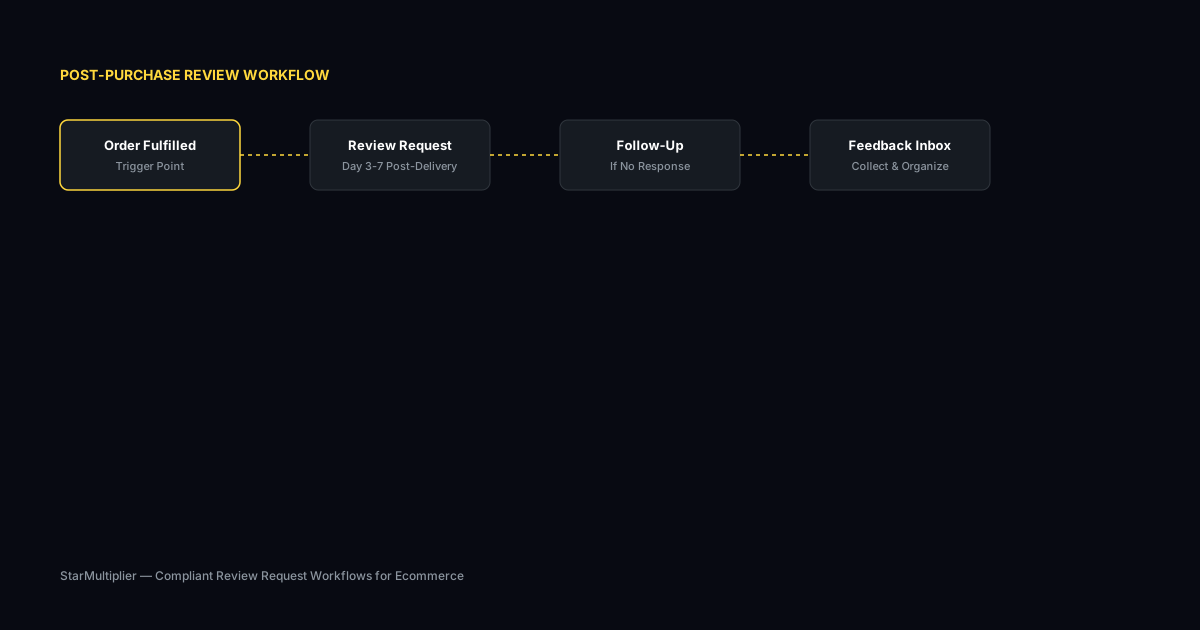
First, define your standard review management process that applies to all clients. Second, implement tracking for key performance metrics across all client accounts. Third, establish a regular reporting cadence that communicates results to clients. Fourth, create a client feedback loop that captures input about the review management service. Fifth, use performance data and client feedback to improve your management process continuously.
Practical examples
An agency managing review collection for twenty clients implemented a centralized dashboard that showed each client's review volume, response rate, and average rating trends. The agency sent monthly reports to each client, and clients could also access the dashboard for real-time data. Client retention improved because the measurable results made the agency's value clear. Another agency created a scorecard system that rated each client's review health, helping clients understand both their current performance and areas for improvement.
Example for growing stores
A mid-size store processing 300 weekly orders implemented automated review requests and saw review volume increase from 15 to 40 reviews per month within eight weeks.
Example for small stores
A boutique store with 50 weekly orders used targeted template messages for first-time buyers and repeat customers separately, improving response rates by 25 percent.
Common mistakes to avoid
One mistake is managing all clients identically without acknowledging their different needs. A one-size-fits-all approach misses opportunities to tailor services for specific industries or store sizes. Another mistake is collecting extensive data but not presenting it in an accessible format for clients. Data is only valuable if clients understand and act on it.
Inconsistent timing
Sending requests at random intervals confuses customers and reduces response rates. Consistent timing based on delivery windows produces better results.
Generic messaging
Using the same message for every customer misses the opportunity to tailor requests by customer segment and purchase history.
ecommerce agency review management checklist
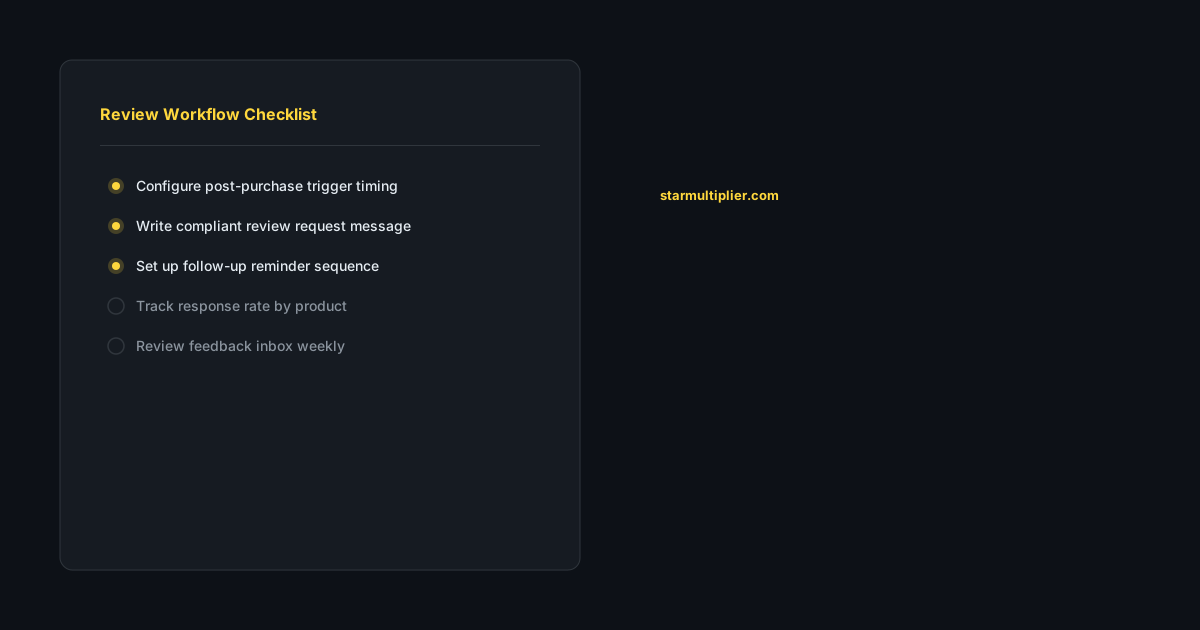
Define a standard management process that can be adapted for different client needs. Implement consistent performance tracking across all client accounts. Establish a regular reporting cadence with clear, accessible data presentations. Create feedback loops to capture client input about your services. Use performance data to demonstrate ROI and identify improvement opportunities.
How StarMultiplier helps with ecommerce agency review management
StarMultiplier provides agencies with the platform infrastructure needed for multi-client review management. Agencies configure each client account with appropriate templates and timing rules, then use the central dashboard to monitor performance across all accounts. The platform's analytics support the consistent reporting that agencies need to demonstrate value to their clients.
Want to see where your review workflow is leaking opportunities? Start with a StarMultiplier review audit.
How ecommerce agencies should structure review management services
Ecommerce agencies offering review management as a service need to define clearly what the service includes, what it excludes, and what responsibilities fall on the client versus the agency. A well-scoped review management service covers the operational execution of review collection: configuring and maintaining the review request workflow, monitoring performance metrics, updating templates when needed, and reporting performance to the client monthly. It excludes the strategic decisions that require client input: which products to prioritize for review collection, what the brand voice should be in review request templates, and how to respond to specific customer concerns raised through reviews. Defining these boundaries in the service agreement prevents scope creep and misaligned expectations about what the agency is accountable for. For the operational components the agency does own, build documented processes that ensure consistent execution across the agency's client portfolio without requiring the primary account manager to manage every detail personally. A review management service that depends on individual account manager expertise rather than documented processes is not scalable and creates quality consistency problems as the agency grows and account assignments change.
Managing review collection compliance across multiple ecommerce clients
Compliance management across multiple ecommerce clients requires the agency to maintain a clear, consistent compliance standard and to apply it uniformly rather than accommodating individual client requests for non-compliant practices. Develop a compliance reference document specific to review collection that describes the practices the agency will and will not implement, with the policy rationale for each prohibition. Share this document with new clients during onboarding so they understand the compliance framework before the service begins rather than discovering it when they request a practice the agency cannot accommodate. Conduct a compliance audit of each new client's existing review collection practices before assuming management responsibility. Clients who have been using non-compliant practices — review gating, satisfaction pre-screening, selective invitation — need to transition to compliant workflows before the agency can take over operations. Document this transition clearly and obtain client acknowledgment that the change from non-compliant to compliant practices may produce some short-term changes in collection outcomes as the workflow adjusts. Stay current on platform policy changes by designating a team member to monitor policy updates from major review platforms quarterly and to update the agency's compliance reference document and client workflows as needed.
Review management reporting that clients value and use
Review management reporting from an agency to clients is most valuable when it provides insights that clients can use to make decisions rather than just data that confirms the service is running. Monthly review management reports should include four sections. The first section is performance summary: how many review requests were sent this month, what was the response rate, how does it compare to last month and to 12 months ago? This section should be a brief, clear dashboard that a client can scan in two minutes. The second section is product-level analysis: which products are generating the strongest review collection performance and which are lagging, and what are the agency's recommendations for addressing lagging products? The third section is feedback insights: what are the most common themes in customer feedback received through the review request process this month, and what do those themes suggest for product improvement or customer service priorities? The fourth section is compliance update: are there any platform policy changes that affect the client's review collection workflow, and what adjustments have been made or are being made in response? This last section demonstrates the agency's proactive compliance management and helps clients understand why certain practices are or are not part of their service.
How to price review management services as an ecommerce agency
Pricing review management services as an ecommerce agency requires covering your costs, reflecting the value you deliver, and remaining competitive with alternative options available to clients. Cost components include: the subscription cost of the review management platform you use for each client, the team time required to set up and maintain each client's workflow, the time required for monthly performance reporting, and the time required for compliance monitoring and quarterly policy reviews. Total these costs at your team's blended hourly rate to establish your cost floor. Value components that justify pricing above cost include: the revenue impact of improved review collection on client store conversion rates, the compliance risk reduction from professional workflow management, the expertise that prevents clients from making costly compliance mistakes, and the ongoing optimization that improves client performance over time. Agency review management services typically price at 2 to 4 times the direct cost floor, depending on the competitive environment and the specific value delivered to the client segment you serve. Package review management as a clearly defined service with explicit deliverables — workflow setup, monthly monitoring, quarterly compliance reviews, monthly reporting — so clients understand exactly what they receive at the stated price.
Delivering review management results that retain agency clients long-term
Retaining agency clients in review management services over the long term requires delivering consistent, measurable results and communicating those results clearly enough that clients understand the value they are receiving. The most effective client retention in review management comes from three practices. First, consistent workflow operation: the review request workflow runs reliably every month without requiring client attention, which is the baseline expectation that justifies the agency relationship. Second, ongoing optimization: response rates improve over time through template testing, timing adjustments, and segmentation refinements rather than settling at the initial performance level after launch. Third, strategic insight: the agency provides proactive observations about client review performance — identifying seasonal trends, flagging compliance risks before they become problems, highlighting product feedback themes that have actionable implications — that go beyond routine reporting. Clients who receive all three practices consistently feel that the agency is actively earning the ongoing relationship rather than collecting fees for work that could be managed internally. The agencies that experience the most client churn in review management are those that excel at practice one but do not invest adequately in practices two and three, delivering reliable service without demonstrating continuous value creation.
Scaling agency review management services efficiently
Scaling agency review management services efficiently requires building standardized processes and technology configurations that can be deployed across new clients without starting from scratch for each engagement. The most efficient agencies develop a standard review management service template: a documented configuration approach for the review platform, a library of base templates for common customer segments and product categories, a standard onboarding checklist that covers all setup steps in a consistent sequence, and a monthly reporting template that can be populated with client-specific data in under an hour. This standardization allows the agency to onboard new review management clients without proportional increases in team time, because each new client starts from a proven foundation rather than a blank configuration. Customization happens at the margins — client-specific brand voice adjustments, additional product category templates, and unique compliance requirements — rather than at the foundation. Document the standard template clearly enough that a new team member can onboard a client following the documented process without requiring extensive guidance from a senior team member who already has the knowledge internalized.