Review Section Best Practices for Ecommerce Product Pages
review section best practices — a practical guide for ecommerce stores. Learn how to build a more effective review collection process with better timing, messaging, and workflow.

Quick answer
review section best practices cover the layout, content, and interactive elements that make a review section helpful for shoppers. Well-designed review sections help customers find the information they need quickly and support faster purchase decisions.
What is review section best practices?
Review Section Best Practices for Ecommerce Product Pages covers the layout, content, and interactive elements that make a review section genuinely useful for shoppers. A well-designed review section helps customers find the information they need quickly and supports faster, more confident purchase decisions.
Why review section best practices matters for ecommerce stores
review section best practices matters because the design of your review section directly affects how shoppers engage with customer feedback. A cluttered or confusing section discourages engagement, while a clean, well-organized section encourages shoppers to spend time reading reviews and building confidence in their purchase.
How to approach review section best practices
The best review section best practices include clear visual hierarchy with summary statistics at the top, easy filtering by rating and recency, prominent photo review displays, helpfulness voting, and consistent mobile and desktop experiences. Each element serves a specific purpose in helping shoppers navigate feedback.
Assess your current review collection process
Start by reviewing how you currently collect reviews. Are you using automated requests, manual emails, or no structured process at all? Understanding your starting point helps you choose the right improvements.
Define your review collection goals
Set realistic targets based on your order volume. A store processing 100 orders per week might target 10-15 new reviews per week with an optimized request workflow.
Implement and iterate
Choose the right approach for your store size and implement it. Monitor response rates and adjust timing, messaging, and targeting based on performance data.
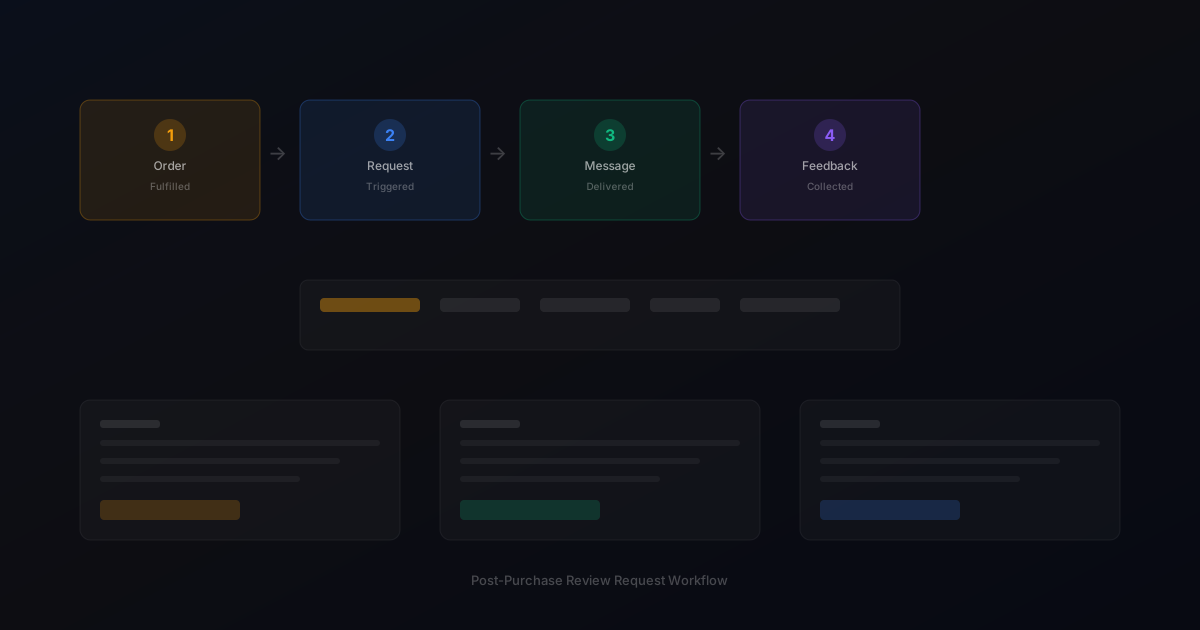
Step-by-step review section best practices framework
1. Start with a clear summary showing average rating, total count, and rating distribution. 2. Offer sorting options: most recent, highest rated, lowest rated, most helpful. 3. Display photo reviews in a visual grid that is easy to browse. 4. Include helpfulness voting to surface the most useful reviews. 5. Ensure the section is fully responsive on mobile devices. 6. Add a Write a Review button that makes submission easy. 7. Test different layouts to find what drives the highest engagement.
Practical examples
A home goods brand tested two review section layouts: one with a horizontal rating distribution chart and one without. The version with the chart saw 15 percent more time spent in the review section and 8 percent higher conversion rates among shoppers who viewed reviews.
Example for growing stores
A mid-size store processing 300 weekly orders implemented automated review requests and saw review volume increase from 15 to 40 reviews per month within eight weeks.
Example for small stores
A boutique store with 50 weekly orders used targeted template messages for first-time buyers and repeat customers separately, improving response rates by 25 percent.
Common mistakes to avoid
The most common mistake is designing the review section without considering mobile users. More than half of ecommerce traffic comes from mobile devices, and a review section that works well on desktop but poorly on mobile undermines the trust-building purpose of the section.
Inconsistent timing
Sending requests at random intervals confuses customers and reduces response rates. Consistent timing based on delivery windows produces better results.
Generic messaging
Using the same message for every customer misses the opportunity to tailor requests by customer segment and purchase history.
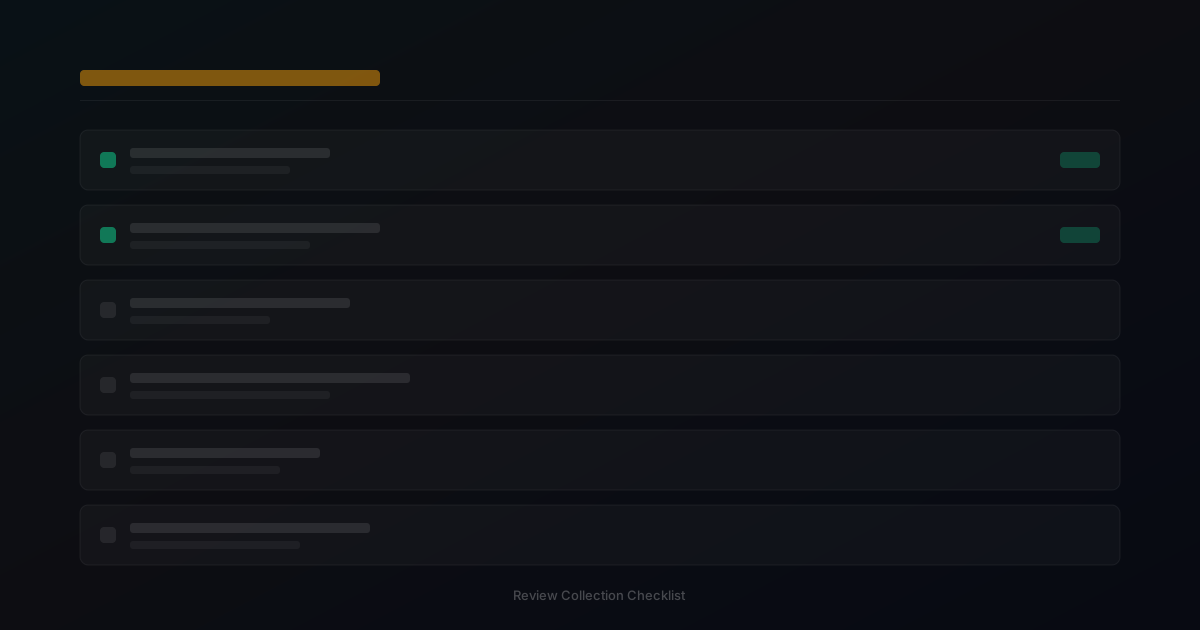
review section best practices checklist
Include a summary block at the top of the section. Offer sorting by rating and recency. Display photo reviews prominently. Add helpfulness voting. Ensure mobile responsiveness. Test different layouts periodically.
How StarMultiplier helps with review section best practices
StarMultiplier helps stores collect the authentic reviews that power well-designed review sections. By improving your review collection workflow with automated timing and effective templates, you ensure your product pages always have fresh customer feedback to display.
Want to see where your review workflow is leaking opportunities? Start with a StarMultiplier review audit.
Review section design best practices that build trust on ecommerce product pages
The design of your review section communicates as much to shoppers as the content of the reviews themselves. A well-designed review section signals transparency, honesty, and confidence in your product. The foundational design principle is that all genuine customer reviews should be visible, not just those above a certain star rating. Filtering negative reviews out of the visible section is both a compliance issue and a design mistake: shoppers who discover that reviews have been filtered lose trust in all the reviews that remain visible. Display your aggregate rating prominently at the top of the section with the total review count in a visible, easy-to-read format. Include a star distribution breakdown showing the count or percentage of reviews at each star level. This distribution chart is one of the highest-trust signals in review design because it demonstrates that your brand is comfortable with the full range of customer feedback being visible. Sort controls that allow shoppers to filter by star rating, sort by most recent, and sort by most helpful empower shoppers to find the information they care about without implying that any reviews are hidden from them.
Review section content best practices for ecommerce
The content quality of your review section depends primarily on the quality of reviews you collect, which is directly influenced by how you ask for reviews and what you prompt customers to share. Reviews that mention specific product features, compare the product to alternatives, describe the customer's use case, or address common pre-purchase questions are more valuable to future shoppers than reviews that simply say 'Great product!' without specificity. In your review request templates, use open-ended prompts that encourage specific feedback rather than generic praise: asking customers what they use the product for, what they like most and least, and whether it met their expectations produces more useful review content than a generic ask for feedback. The best review sections include a mix of ratings — not all five-star — and a mix of detail levels, with some short and direct reviews alongside more detailed ones. They also include a mix of customer perspectives: customers who bought for different use cases, customers who are experienced in the product category, and first-time buyers who can speak to the discovery experience. Building this diversity of review content is not about curating which reviews appear — all genuine reviews should appear — but about collecting from a broad enough customer base that diverse perspectives are represented.
Review section technical implementation best practices
The technical implementation of your review section affects how effectively reviews contribute to your product page's SEO performance and how reliably review content loads for all shoppers. Server-side rendering of review content ensures that search engine crawlers can index reviews as part of your product page HTML, contributing review keywords and content to your product page's search relevance. Client-side JavaScript rendering of reviews may not be indexed by all search engines, which means your review content may not contribute to search ranking even though it is visible to shoppers. Implement Product and AggregateRating structured data in JSON-LD format on every product page that has reviews. This markup enables rich snippet display — the star ratings that appear in Google search results — which can significantly improve click-through rate from search results to your product pages. Use pagination for review sections rather than infinite scroll, as pagination is more reliably indexed by search engines and provides a better experience for users on slower connections. Lazy load review images and complex review widgets to prevent them from affecting your Core Web Vitals scores, particularly Largest Contentful Paint, which is a Google ranking factor.
Review section best practices checklist for ecommerce product pages
Use this checklist to evaluate your review section against established best practices for conversion-focused ecommerce product pages. Is the aggregate rating displayed prominently near the top of the product page rather than only in the review section? Is the total review count visible next to or below the aggregate rating? Does the review section include a star distribution breakdown for products with more than 20 reviews? Is the default sort order set to most helpful or most recent rather than highest rating? Are reviews paginated rather than infinite-scrolled for better performance and SEO? Is customer-submitted review imagery visible without requiring expansion of individual reviews? Is the review submission process accessible from the product page without requiring account creation? Does the review section include schema markup in JSON-LD format for AggregateRating? Are brand responses to reviews visible alongside the reviews they address? Are the first three visible reviews specific, detailed, and from within the past six months? Is the review section mobile-responsive with readable font sizes and touch-friendly interactive elements? Do filtering options allow shoppers to sort by star rating, recency, and helpfulness?
How to test whether your review section best practices are improving conversion
Testing whether review section improvements are actually improving conversion requires connecting your review section changes to measurable conversion metrics in a controlled way. The most rigorous approach is a proper A/B test where half your product page visitors see the current review section and half see the improved version, with add-to-cart rate or checkout initiation rate as the primary metric. This requires a testing platform like Google Optimize, Optimizely, or your ecommerce platform's built-in testing features, and sufficient product page traffic to produce statistically significant results within a reasonable test period. For product pages with lower traffic that cannot support proper A/B testing, use before-and-after analysis: implement the review section improvement, then compare conversion metrics from the 30 days before the change against the 30 days after the change, controlling for seasonal factors and traffic mix changes that might confound the comparison. Document every review section change with the date it was implemented so you can attribute conversion changes to specific improvements rather than to general business trends. Over time, a collection of documented review section improvement tests — both successful and unsuccessful — builds an institutional knowledge base about what affects conversion on your specific product pages.
Making your review section accessible to all shoppers
Review section accessibility is an area where ecommerce product pages frequently fall short of both legal accessibility standards and best practices for inclusive design. Screen reader compatibility requires that star rating displays have text equivalents — a star display that renders as five filled stars should also include text that reads '4.8 out of 5 stars based on 247 reviews' for screen reader users. Color contrast between review text and the page background must meet WCAG AA standards (minimum 4.5:1 contrast ratio for normal text) to be readable for users with low vision. Review filter and sort controls must be keyboard-navigable without requiring mouse interaction. Review images must include descriptive alt text for screen reader users. Form elements in the review submission flow must have proper label associations rather than relying only on placeholder text. These accessibility improvements benefit all users through improved semantic structure and clarity, but they are specifically important for customers with disabilities and for compliance with accessibility requirements that increasingly apply to ecommerce sites.