Review Reminder Email Template for Ecommerce Stores
review reminder email template — a complete guide for ecommerce stores. Learn how to evaluate tools, use effective templates, and build a compliant review collection workflow that drives authentic customer feedback.
Quick answer
A review reminder email template gives customers who missed the initial request a second opportunity to share feedback. Reminder templates should add value rather than pressure, and should clearly communicate why the customer's perspective matters to your store and to other shoppers.
What is review reminder email template?
Review Reminder Email Template for Ecommerce Stores starts with understanding what your store actually needs from a review collection process. Whether you are evaluating dedicated platforms, comparing approaches, or building a workflow from scratch, the goal is the same: collect authentic customer feedback efficiently and compliantly.
Why review reminder email template matters for ecommerce stores
For ecommerce stores, review reminder email template matters because product reviews directly influence purchase decisions. Shoppers trust peer feedback more than brand messaging, and stores with solid review volumes see higher conversion rates, better customer retention, and stronger organic search presence.
How to approach review reminder email template
Building an effective review reminder email template strategy starts with defining your review collection goals. How many reviews do you need per product? What response rate are you targeting? Which customer segments are most likely to leave detailed feedback? Once you have clear targets, you can evaluate which approach fits best.
Assess your current review collection process
Start by reviewing how you currently collect reviews. Are you using manual emails, a basic Shopify app, or no structured process at all? Understanding your starting point helps you choose the right next step.
Define your review volume targets
Set realistic targets based on your order volume and current review rates. A store processing 100 orders per week might target 10-15 new reviews per week with an optimized request workflow.
Choose your approach and implement
Based on your assessment and targets, choose between manual templates, a dedicated review request tool, or an integrated platform like StarMultiplier. Implement your chosen approach and monitor results.
Step-by-step review reminder email template workflow
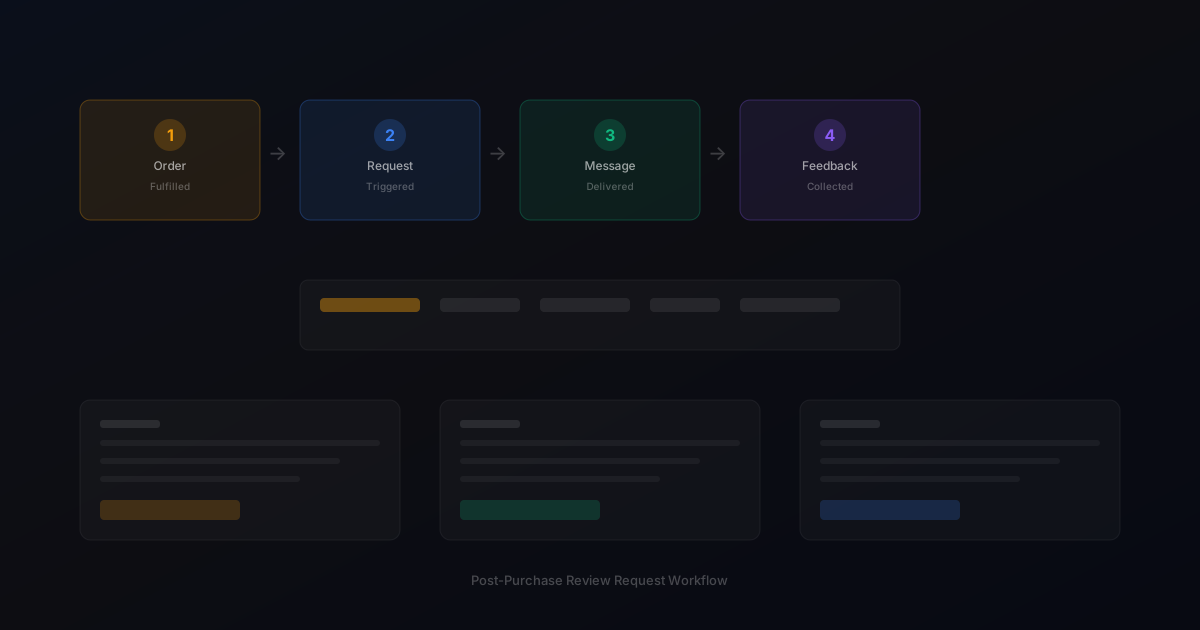
1. Connect your ecommerce platform to your review request tool. This enables automatic trigger based on order status. 2. Set timing rules for when requests go out after delivery confirmation. 3. Write request templates that match your brand voice for different customer segments. 4. Configure follow-up timing for customers who do not respond to the first request. 5. Monitor response rates and adjust timing and messaging based on performance data. 6. Connect your feedback inbox so responses route to the right team members.
Real-world examples of review reminder email template
Consider a store that sells home goods and processes 200 orders per week. With a manual email workflow, someone on the team needs to export orders daily, write personalized messages, and track responses in a spreadsheet. With review reminder email template, the store sets up automated triggers that send review requests three days after delivery confirmation and track all responses in a central dashboard.
Small store example
A boutique store with 50 orders per week implemented automated review requests and saw review volume increase from 5 to 18 reviews per month within six weeks.
Growing store example
A mid-size Shopify store processing 500 orders weekly reduced manual follow-up time by 12 hours per week after switching from manual emails to an automated review request workflow.
Common mistakes with review reminder email template
One common mistake with review reminder email template is sending review requests too early, before the customer has had a reasonable chance to use the product. This leads to low response rates and feedback that lacks useful detail about the product experience.
Inconsistent timing
Sending requests at random intervals confuses customers and reduces response rates. Consistent timing based on delivery confirmation produces better results.
Generic messaging
Using the same message for every customer ignores the different relationships first-time, repeat, and high-value customers have with your brand.
review reminder email template checklist
Define your target review volume per product category. Choose your review request timing based on delivery confirmation windows. Write segment-specific request templates for different customer types. Set up automated triggers connected to your ecommerce platform. Configure a single follow-up reminder for non-responders. Connect your feedback inbox for team response workflows. Monitor response rates and adjust timing based on data. Review platform compliance policies quarterly.
Want to see where your review workflow needs more policy awareness? Start with a StarMultiplier review audit.
How StarMultiplier helps with review reminder email template
Review Reminder Email Template for Ecommerce Stores is where StarMultiplier fits naturally. The platform connects to your Shopify store, automates review request timing based on order fulfillment, and provides pre-built templates for different customer segments. Your team can monitor response rates, manage feedback, and adjust messaging from a single dashboard without technical setup or ongoing manual work.
Automated post-purchase review requests
StarMultiplier connects to your Shopify store and automatically triggers review requests after order fulfillment, with timing you control.
Segment-specific templates
Use different messaging for first-time buyers, repeat customers, and high-value orders to improve response rates across segments.
Feedback dashboard and analytics
Monitor response rates, review volume trends, and customer sentiment from a central dashboard without manual data collection.
The anatomy of an effective review reminder email
A review reminder email must accomplish a specific task: recapture customers who received your initial review request but did not act on it, without making them feel harassed or creating a negative impression of your brand. The effective reminder template has a different structure than the initial request because the customer already knows why you are writing and does not need the same level of context and motivation. The subject line should acknowledge the reminder context lightly: 'Just a quick follow-up on your [Product Name] order' or 'In case you missed it — your experience matters to us' both signal that this is a follow-up without being demanding or impatient. The opening should be brief: one sentence that references the original request and acknowledges that the customer may have been busy. Do not reproduce the full text of your original review request in the reminder — customers who received the first email do not need it repeated, and those who missed the first email can get the context they need from a shortened version. The call to action should be identical to the original request: the same review platform link, the same clear button or text link, with no additional asks or secondary CTAs. Close with a genuinely brief sign-off that thanks the customer for their time regardless of whether they respond.
Timing rules for sending review reminder emails
The timing of a review reminder email requires balancing the goal of recapturing non-responders with the risk of creating a negative experience for customers who have already decided not to leave a review. The standard best practice is to send the reminder 5 to 7 days after the original review request, which gives non-responders enough time to have received and read the first email while still being within a window where the purchase is recent enough to review. Sending the reminder within 2 to 3 days of the original request often reaches customers who have seen the first email but have not yet had time to act on it, creating a perceived spam experience rather than a useful reminder. Sending the reminder more than 14 days after the original request reaches customers at a point when the purchase may have faded sufficiently from memory that motivation is lower and recall for specific product details is weaker. Configure your reminder timing based on your specific customer behavior data if available. Some customer segments, such as business buyers who check email on a regular schedule, may respond better to shorter reminder intervals, while consumer-facing brands with high mobile engagement may see better results with longer intervals that allow the customer to encounter the reminder in a different context than the original request.
What to avoid in review reminder emails
Review reminder emails fail most often because of avoidable mistakes in tone, timing, or content. The most damaging mistake is implying urgency or pressure: phrases like 'Last chance to leave your review' or 'You still have not reviewed your purchase' create a negative emotional response in customers who had already decided to skip the review. Pressure tactics reduce both response rates and the quality of any reviews you receive from customers who respond out of obligation rather than genuine motivation. A second common mistake is sending multiple reminders. One follow-up reminder is appropriate; two or three is harassment regardless of how politely worded. If a customer has not responded after your initial request and a single reminder, they have communicated clearly that they do not intend to review this purchase. Honor that signal and do not send additional contacts. A third mistake is not suppressing the reminder for customers who have already completed a review between the original request and the reminder send date. Sending a review reminder to a customer who has already reviewed your product is confusing, wastes email sends, and suggests your system is not tracking reviews correctly.
Checklist for a compliant and effective review reminder email
Before sending any review reminder email, verify it meets these requirements. Is it clearly identified as a follow-up to your previous review request, without being demanding about the non-response? Is the subject line different from the initial review request subject line so customers who saw the first email recognize this as a different message? Is the email shorter than your initial review request — ideally under 100 words? Does it contain exactly one review platform link with the same destination as the initial request? Does it avoid language that implies urgency, pressure, or obligation — phrases like 'last chance,' 'you still have not,' or 'please respond immediately' are counterproductive? Does it include an easy opt-out for customers who do not want to receive review requests? Is it suppressed for customers who completed a review between the initial request and the reminder send date? Is it suppressed for customers who initiated a return or exchange between the initial request and the reminder? Does it maintain the same brand voice and visual style as the initial review request? Is the sender name and email address identical to the initial review request to maintain recognition?
How to improve reminder email performance without increasing pressure
The most effective review reminder email improvements focus on reducing friction and increasing relevance rather than on increasing pressure or urgency, which consistently produces negative results. The most impactful low-pressure improvement is personalizing the reminder more specifically to the product purchased. If your initial review request already includes the product name, the reminder can add a specific product detail — the color, size, or model the customer chose — to increase the sense that the message is specifically about their unique purchase rather than a generic follow-up. A second improvement is adding a sentence that reduces the perceived effort of completing a review: 'It only takes a minute or two, and even a brief rating helps other shoppers.' Research on review completion barriers consistently identifies perceived effort as a major reason customers who intend to review never do, and reducing that perception increases completion rates without adding pressure. A third improvement is adding a direct question in the reminder that the customer can answer by clicking the review link: 'How has the [Product Name] been working for you?' frames the review request as a conversation rather than a task, which is more engaging for customers who have not yet been motivated by a direct ask.