Review Collection for DTC Brands: Building Authentic Social Proof
Direct-to-consumer brands depend on authentic social proof to compete against established retailers. Learn how to build a review collection strategy that reflects your brand's genuine customer relationships.
Quick answer
DTC brands should build review collection around authentic customer relationships, focusing on specific, detailed reviews that reflect the genuine brand experience rather than volume for its own sake. Segment outreach by customer relationship stage and invite detailed feedback that speaks to DTC brand differentiators.
Why review collection is uniquely critical for DTC brands
Direct-to-consumer brands operate without the marketplace ecosystem that provides social proof scaffolding to brands sold on Amazon or other platforms. A DTC brand's product pages are the primary location where potential customers evaluate social proof, and those pages are entirely dependent on the brand's own review collection efforts. Unlike marketplace brands that benefit from platform-level review visibility, DTC brands must build their social proof infrastructure independently and maintain it actively. Additionally, DTC brand customers often have a more involved relationship with the brand than marketplace customers — they discovered the brand through a specific channel, engaged with the brand's content or advertising, and chose to purchase directly rather than through a third party. This higher engagement level creates a customer base that is more likely to respond to review requests and to write more detailed, brand-specific reviews than marketplace customers who may have little brand affinity beyond the product itself.
Leveraging the DTC customer relationship in review requests
DTC brand review requests can leverage the direct customer relationship more explicitly than marketplace review requests because the customer chose to engage with your brand specifically rather than simply purchasing a product that happened to be available on a marketplace. References to the customer's origin story — how they discovered the brand, what brought them to purchase — add a layer of personalization that is genuinely relevant to the DTC context. 'We are so glad you found us through [channel/community/referral context]' is a meaningful opening for a DTC review request that would seem out of place in a marketplace context. DTC review requests can also more explicitly reference the brand's values and mission — the reasons customers choose DTC over marketplace alternatives — since DTC customers are more likely to have chosen the brand in part because those values resonate with them. A review request that acknowledges 'part of why we do this directly is so we can have real conversations with customers like you about their experience' creates a brand narrative context that DTC customers respond to more than the transactional framing that works adequately for marketplace contexts.
Building review content that speaks to DTC brand differentiators
DTC brands compete on differentiation — values alignment, product quality, brand story, customer service — that makes detailed reviews more valuable than simple star ratings. A 4.8 star average with reviews that say 'great product' tells potential customers very little about the differentiators that motivated the purchase decision. A 4.5 star average with reviews that say 'the quality is noticeably better than the version I bought at a department store — the materials are premium and the fit is exactly what they describe' speaks directly to the quality and accuracy differentiation that is central to most DTC brand propositions. Encourage specific reviews by designing review request prompts that ask about the dimensions most relevant to your brand's differentiation. For a quality-focused DTC apparel brand: 'How does the quality compare to what you expected? How has it held up to washing?' For a values-focused DTC food brand: 'How has [Product] fit into your daily routine? What do you notice about the difference in quality?'
Review distribution strategy for DTC brands without marketplace presence
DTC brands without marketplace presence must build their review presence across the destinations where potential customers research before purchasing, since they cannot benefit from marketplace-level review aggregation. The primary destination for most DTC brands is the brand's own product page — on-site reviews that appear directly to visitors who have already discovered the brand and are evaluating their purchase decision. The secondary destination for DTC brands with physical or shipping presence in a specific market is Google Business Profile — Google reviews appear in branded search results and in Google Shopping, reaching potential customers before they visit the brand's site. For DTC brands building category authority, third-party review platforms (Trustpilot, Yotpo,Okendo) provide an independent review destination that sophisticated shoppers may consult when evaluating a brand they discovered through advertising. Direct all review request links to the destination most likely to be consulted by the next customer similar to the one who just reviewed.
Creating a DTC brand review voice that builds community
DTC brands with strong community elements — a brand that customers identify with and advocate for beyond transactional purchase behavior — can build their review collection around community belonging rather than purely product evaluation. Review requests that frame the ask as a contribution to the community ('Your review helps other [brand community members] make confident decisions about trying [Product]') create a social motivation for reviewing that is distinct from, and complementary to, the altruistic motivation of helping the brand or the transactional motivation of doing what the brand asked. This community framing is particularly effective for DTC brands with active social communities — outdoor brands, fitness brands, food brands with strong lifestyle positioning — where customers already identify as community members and are predisposed to contribute to collective community resources. Building a review voice that extends the community into the review experience creates a natural extension of the DTC brand's relationship-first positioning into the post-purchase social proof space.
Want to see where your review workflow is leaking opportunities? Start with a StarMultiplier review audit.
Measuring DTC brand review performance against DTC benchmarks
DTC brands should calibrate their review collection performance expectations against DTC-specific benchmarks rather than general ecommerce averages, because the customer relationship quality and engagement levels that are typical for DTC brands produce higher baseline response rates than are typical for general ecommerce or marketplace brands. DTC brands with strong customer acquisition through content or community channels — where customers have a higher affinity for the brand before purchasing — typically achieve review request response rates of 8 to 15 percent, compared to 3 to 6 percent for general ecommerce stores. If your DTC brand's review collection response rate is significantly below 8 percent, the gap represents a meaningful opportunity, since the underlying customer affinity that DTC brands benefit from should support higher engagement with post-purchase communications. Investigate underperformance relative to DTC benchmarks by checking whether your templates reflect the brand voice and relationship context that motivated customers to choose your brand directly rather than through a marketplace.
DTC brand review programs and the owned media advantage
Direct-to-consumer brands have a significant structural advantage in review collection that marketplace brands lack: owned customer relationships and owned communication channels. A DTC brand with an engaged email list, an active social community, and a Shopify store captures customer data and communication permission at the point of sale in a way that allows direct, personalized post-purchase review collection without depending on marketplace algorithms or third-party review invitation systems. This owned media advantage compounds over time: every customer who purchases from your DTC store joins your customer database, enabling direct review collection outreach, lifecycle marketing, and retention communications that build the customer relationship that makes review requests effective. Invest in owned media infrastructure — email list quality, post-purchase communication flows, and customer data completeness — as a foundation for review collection excellence, because the quality of your owned media directly determines the effectiveness of your review collection outreach.
Community-driven review programs for DTC brands with strong audiences
DTC brands that have built strong audiences — a loyal following on social media, an active email list, a community forum or membership — can amplify their review collection through community-driven programs that leverage social proof creation as a community participation behavior rather than purely a transactional response to a marketing request. A community review challenge — 'Share your [Product Name] experience this week and we will feature the most detailed review on our product page' — activates the community participation motivation that drives engagement among brand enthusiasts, while producing specific, informative review content that benefits all potential buyers who read the product page. Community-driven programs require careful compliance design: participation must be optional, incentives must be properly disclosed, and the review content produced must represent genuine customer experiences rather than community-curated positive sentiment that misleads potential buyers about the typical experience. When designed correctly, community review programs produce the highest-quality, most specific review content of any collection approach because they attract the most engaged customers who have the strongest opinions and the most detailed experiences to share.
DTC review collection and first-party data strategy
DTC review collection is inherently a first-party data strategy because it generates customer feedback data that lives in your owned systems rather than on third-party marketplace platforms that control the data and can restrict access. The review content, reviewer profiles, and response patterns your DTC review program generates constitute a first-party data asset that can be analyzed, segmented, and applied in ways that third-party marketplace review data cannot. Use your DTC review data to identify the product attributes that most strongly predict satisfaction (appearing frequently in positive reviews) and dissatisfaction (appearing in critical reviews), and feed these findings directly into product development, marketing messaging, and customer service scripting. The language customers use in authentic reviews to describe your products is also a first-party keyword intelligence source for SEO and content strategy — the specific phrases your actual customers use when describing their product experience often overlap with the search queries that prospective customers use when looking for products like yours.
Checklist
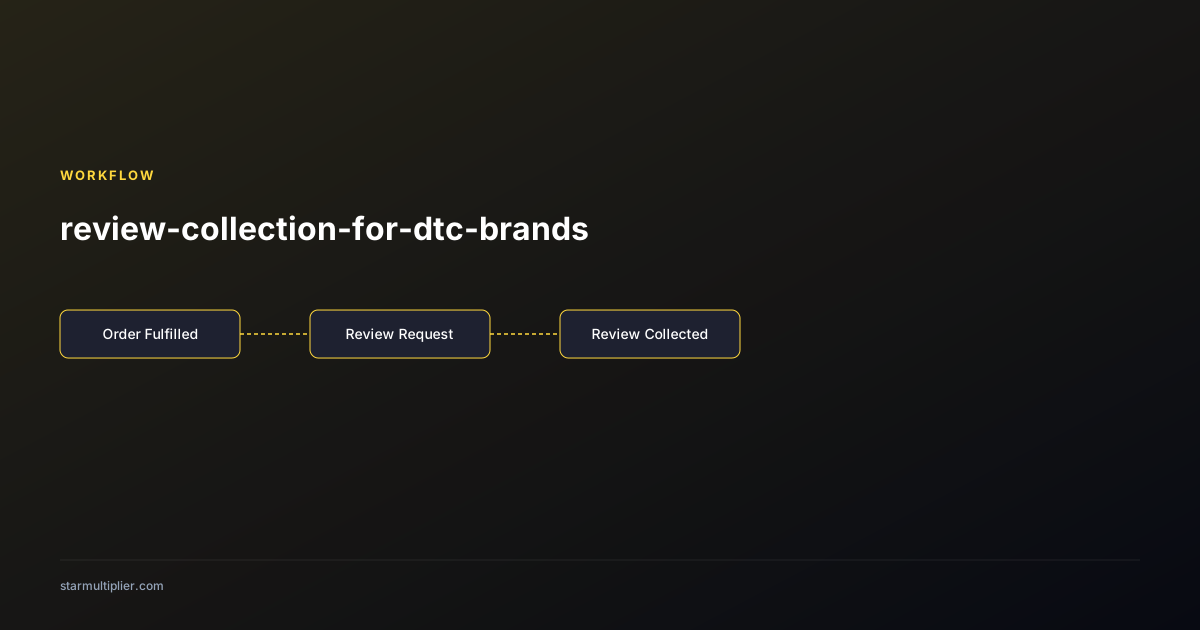
- Write review request templates that reference the DTC customer relationship explicitly
- Include brand-relevant review prompts that ask about your key differentiators
- Direct on-site product page reviews as the primary destination for DTC customers
- Add Google Business Profile as secondary destination for branded search visibility
- Benchmark response rate against DTC standards (8-15%) rather than general ecommerce
- Encourage detailed reviews with specific prompting questions in the request
- Review and update DTC brand voice in review request templates annually